
English 
+86-157-6313-9515
lina@hezongmaterials.com
lina@hezongmaterials.com
26 Jiashan Road, Chucun Town, Weihai City, Shandong Province, China


Views: 0 Author: Site Editor Publish Time: 2026-10-04 Origin: Site


Engineers face a constant dilemma in high-performance design. We must balance maximum structural rigidity against strict weight limitations. You see this challenge daily in aerospace assemblies. Marine vessels and commercial vehicles require intense lightweighting protocols. Every single gram matters. However, components must never fail under load. This article provides an objective, data-driven framework. We will help you choose between monolithic composite structures and advanced sandwich structures. You will learn the baseline structural differences first. Monolithic structures rely on dense layers of fibers pressed tightly together. Sandwich structures separate thin composite skins using a lightweight core material. We evaluate critical criteria like deflection tolerances and specific load types. We also cover essential machining requirements and integration challenges. By the end, you will understand exactly how to select the right material. You can then confidently meet your structural requirements without compromising overall system performance.
Solid carbon fiber plates deliver superior tensile strength and localized impact resistance, making them ideal for thin-profile spaces and components requiring extensive drilling or threading.
Carbon fiber honeycomb panels offer exponentially higher bending stiffness-to-weight ratios, heavily favored in applications where panel deflection and overall payload weight are the primary constraints.
Selecting the right material requires evaluating secondary operational factors, including thermal/acoustic insulation needs, edge-sealing requirements, and specific fastening methods.
Working with manufacturers capable of producing custom composite parts is often necessary to solve the fastening and edge-closure challenges inherent to honeycomb structures.
Every engineering project begins by defining clear success criteria. You must frame the primary structural problem accurately. Ask yourself what the system truly needs to achieve. Do you need to increase payload capacity in heavy commercial vehicles? Are you trying to reduce battery consumption in automated aerial drones? Perhaps your primary goal involves passing strict structural deflection tests under heavy aerodynamic loads. Defining this success metric determines your material path.
You must address the fundamental trade-off between weight and stiffness. Monolithic composite laminates provide incredible strength. However, simply adding thickness yields diminishing returns regarding weight efficiency. If you double the thickness of a solid laminate, you double its mass. A solid panel becomes excessively heavy very quickly. We need a fundamental structural shift when rigidity dictates the design.
Identifying your specific load type represents the most critical evaluation step. You must map how forces interact with your structural components. We recommend following these precise evaluation steps:
Analyze Load Distribution: Determine if forces spread evenly across the surface. Distributed loads strongly favor sandwich structures.
Locate Point Loads: Identify areas experiencing concentrated stress. High point loads and high shear stresses demand dense, solid materials.
Define Space Limits: Measure your available profile envelope. Extremely tight clearances restrict your ability to use thick structural cores.
Calculate Deflection Tolerances: Establish the maximum allowable bend before system failure occurs.
Monolithic composites possess an incredibly dense mechanical profile. Manufacturers stack multiple layers of prepreg carbon fiber. They press and cure these layers under high heat and immense pressure. This meticulous process eliminates voids. It creates a solid, unified block of structural material. The resulting laminate delivers massive tensile and compressive strength. The fibers carry loads efficiently across the entire part geometry.
Certain applications demand this dense material profile. You should use solid carbon fiber plates for heavy-duty brackets. They excel as primary mounting plates and internal chassis components. They fit perfectly into assemblies facing severe space restrictions. Imagine a scenario where a mere 2mm thick part must bear significant mechanical stress. Only a solid laminate can survive this concentrated force without crushing.
Implementation advantages make solid laminates highly favorable for complex machining. Machinability remains a huge operational benefit. You can tap, drill, and countersink solid laminates easily using standard abrasive tooling. You do not need specialized metallic inserts. Potting compounds are completely unnecessary. Engineers can treat these laminates much like high-grade aluminum during the fabrication phase.
We must also acknowledge the primary limitation. Scaling up presents a major engineering problem. Covering large surface areas creates a severe weight penalty. Preventing bending across large spans requires extremely thick plates. A thick solid plate adds unnecessary mass to your assembly. This mass degrades performance in aerospace and automotive applications.
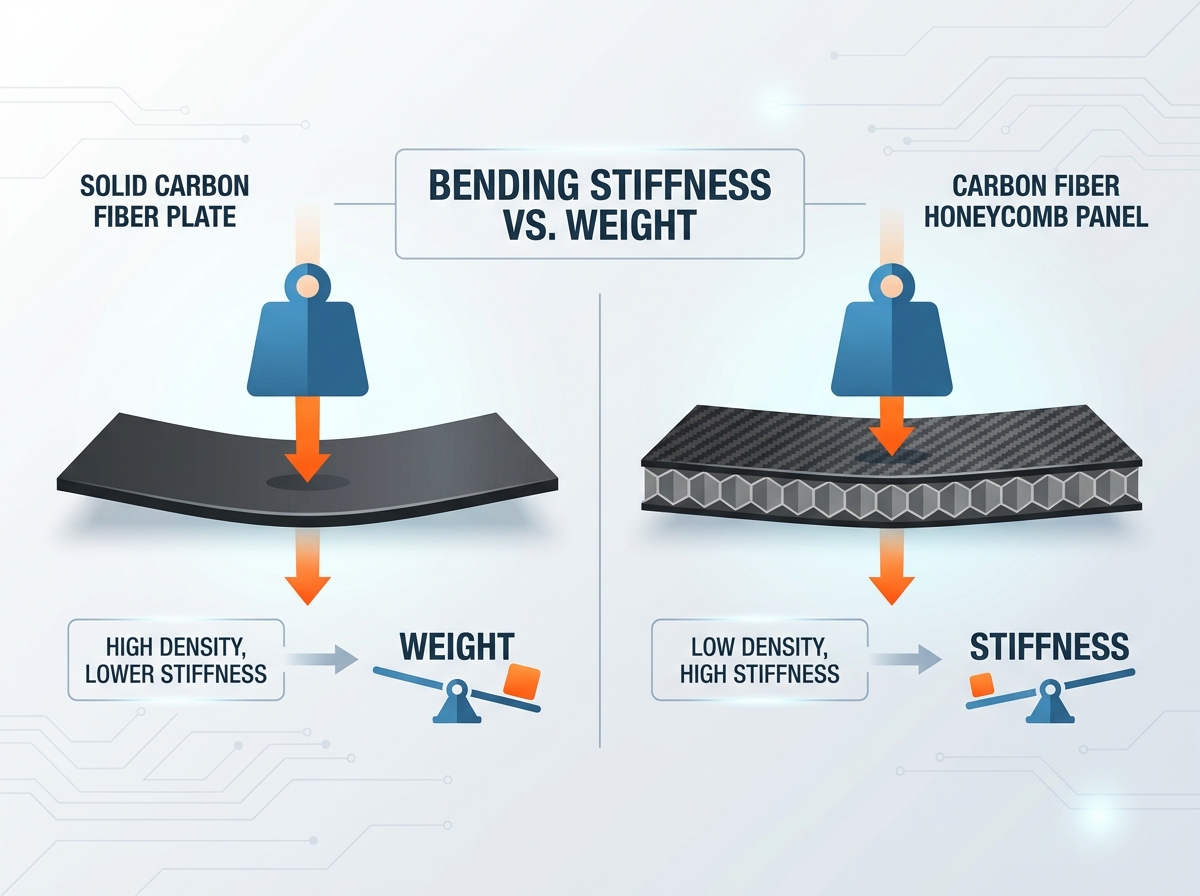
Sandwich structures completely rewrite the rules of structural engineering. We separate two thin composite skins using a lightweight internal core. Common core materials include aramid, Nomex, or specialized aluminum matrices. This separation effectively increases the moment of inertia. By pushing the load-bearing skins away from the neutral axis, we multiply rigidity. We achieve this while adding almost zero overall mass.
The core benefit becomes obvious during thickness scaling. If you double the thickness of a sandwich panel, you drastically increase its rigidity. The weight increase remains incredibly marginal. This geometry defines the true advantage of carbon fiber honeycomb panels. They provide a structural backbone for enormous structures while feeling virtually weightless in your hands.
Secondary performance metrics often dictate final material selection. Sandwich structures inherently dampen mechanical vibrations. They provide excellent acoustic and thermal insulation capabilities. Monolithic laminates conduct heat and transmit noise very quickly. A sandwich structure blocks these elements efficiently. This makes them highly valuable for operator cabins and sensitive instrument housings.
Ideal applications leverage these exact properties. Engineers specify them for large marine bulkheads. They serve as primary flooring structures for heavy commercial vehicles. You will find them throughout aerospace interior panels. Automated robotic arms also benefit immensely from the low inertia. A lighter arm moves faster and stops more precisely.
We must compare deflection ratios directly. Imagine a solid laminate and a sandwich structure of the exact same mass. We apply an identical center-point load to both parts. The solid laminate will bend significantly. The sandwich structure will exhibit virtually zero deflection. Real-world comparative ratios show that sandwich structures deliver exponential stiffness multipliers. Moving the carbon fiber skins just 10mm apart creates a structural beam. It resists bending forces infinitely better than a solid sheet of equal weight. You do not just gain a small percentage of rigidity. You fundamentally change the deflection curve.
Integration strategies differ vastly between these materials. Solid laminates accept standard CNC routing effortlessly. You can utilize traditional mechanical fastening techniques. Bolts, rivets, and tapped threads hold securely within the dense matrix.
Sandwich panels force you to address a different implementation reality. You cannot crush the fragile internal core. Standard bolts will simply collapse the structure. You must utilize specialized integration techniques:
Potted Inserts: You must inject liquid epoxy into the core area before inserting threaded hardware.
Through-Hole Reinforcements: Drilling completely through requires solid carbon sleeves to protect the internal void.
Edge Close-Outs: Exposed core edges invite moisture. You must seal perimeters using solid composite strips or specialized resins.
Impact resistance profiles vary significantly. Solid laminates handle blunt impacts incredibly well. They distribute shockforces through their dense layers. They survive heavy tool drops and rough mechanical handling.
Sandwich skins remain highly susceptible to localized damage. A sharp point load can puncture the thin outer skin easily. If the skin is too thin, sharp objects will penetrate directly into the core. Delamination can occur under repetitive point-load stress. You must design adequate skin thickness if your operational environment involves sharp impacts or abrasive strikes.
Comparison of Structural Material Properties
Performance Feature | Solid Carbon Laminate | Honeycomb Sandwich Structure |
|---|---|---|
Bending Stiffness (Per KG) | Low | Extremely High |
Tensile Strength | Maximum | Moderate (Skin dependent) |
Machinability & Fastening | Standard tooling & tapping | Requires potting & inserts |
Point-Load Resistance | Excellent | Vulnerable to puncture |
Vibration & Acoustic Damping | Poor | Excellent |
Navigating the supply chain requires careful attention to customization realities. Standard flat sheets exist readily in the market. However, integrating these basic sheets into advanced final assemblies proves difficult. You cannot simply cut a standard sandwich panel and leave the core exposed. Doing so compromises structural integrity immediately.
Most engineering teams solve this by sourcing custom composite parts directly from capable manufacturers. A custom manufacturing approach allows you to specify pre-installed hard points exactly where your design requires them. It guarantees professional, watertight edge sealing. You can also specify exact core densities for different zones of the same part. This level of customization prevents catastrophic failures in the field.
Engineers must also highlight critical adoption risks regarding material compatibility. Galvanic corrosion represents a massive danger. If you combine an aluminum honeycomb core directly against carbon fiber skins, you create a battery effect. Add moisture or saltwater, and the aluminum core will corrode rapidly. This destroys the panel from the inside out. You must mandate proper fiberglass isolation layers to prevent this reaction. Alternatively, we highly recommend specifying aramid or Nomex cores. These non-metallic cores completely eliminate conductivity risks in wet or marine environments.
Choosing the correct structural material dictates the ultimate success of your engineering project. A clear decision matrix simplifies this process. Choose solid monolithic components when you face severe space constraints. Rely on them for high-point-load environments. Specify them when your assembly demands simple, extensive mechanical fastening.
Conversely, choose sandwich structures for large-span applications. Deploy them whenever overall payload weight poses a strict constraint. They deliver unmatched bending stiffness while providing valuable thermal and acoustic insulation.
Your next step requires precise mathematical definition. Finalize your maximum deflection tolerances today. Calculate your exact structural weight limits. We strongly advise engineers to submit their CAD drawings and load requirements directly to a composite manufacturing specialist. A technical consultation ensures you select the perfect material, core density, and edge-sealing strategy for your demanding application.
A: You cannot use standard bolts directly, as they will crush the fragile core. Engineers must use bonded metallic inserts. We inject potting compounds (like specialized epoxy) into the core cavity to create a solid localized block. We then install threaded inserts into this cured compound. Localized solid carbon reinforcements are also used during manufacturing.
A: Yes, but abrasive cutting tools work best to prevent splintering the thin skins. The reality of machining requires post-processing. Whenever you cut a sandwich panel, you expose the internal core. You must properly seal these exposed edges using resins or composite strips to prevent moisture ingress and internal delamination.
A: It depends on the force direction. Solid laminates win decisively regarding raw tensile strength and point-load crush resistance. However, sandwich structures offer vastly superior bending stiffness per pound. If you want to stop a part from bending across a large gap, the sandwich structure performs much better structurally.
A: Both materials boast exceptional lifespans. Solid laminates are highly resilient against harsh environmental factors. Sandwich structures demand strict adherence to edge-sealing protocols. If a seal fails, water enters the core. Freeze-thaw cycles or galvanic corrosion will degrade the core rapidly, drastically shortening the panel's operational lifecycle.


