
English 
+86-157-6313-9515
lina@hezongmaterials.com
lina@hezongmaterials.com
26 Jiashan Road, Chucun Town, Weihai City, Shandong Province, China


Views: 0 Author: Site Editor Publish Time: 2026-10-17 Origin: Site


Professional-grade gear requires a high initial investment. You expect it to perform flawlessly in demanding field environments. When your equipment slips under heavy loads or seizes completely, operational disruption follows quickly. Dropped gear and lost hours cost serious money. These locking failures rarely stem from material defects in the carbon fiber itself. Instead, they usually indicate severe clamp fatigue, improper cleaning maintenance, or mismatched environmental use. We wrote this guide to provide a clear technical framework for diagnosing these exact locking failures. You will learn how to properly inspect and maintain your current equipment. We will also help you evaluate when you should repair your gear versus when to upgrade to modular systems. By following these steps, you can keep your specialized poles operating smoothly for years.
Root Causes: Most locking failures stem from resin polishing (loss of friction), micro-debris in the clamping mechanism, or thermal expansion disparities between the pole and the lock.
Maintenance Rule: Never use petroleum-based lubricants on carbon fiber; dry cleaning and specialized dry PTFE sprays are the standard.
Smart Upgrades: Modular designs featuring replaceable carbon fiber pole sections drastically lower long-term expenses compared to glued or sealed systems.
Purchase Criteria: Upgrading requires evaluating lock serviceability, section overlap ratios, and replacement part availability.
We must understand why joints fail before we can fix them. The mechanics are simple but unforgiving. Repeated extension and retraction eventually smooth out the epoxy resin coating. This constant friction causes resin polishing over time. It reduces the vital friction coefficient needed for stability. Twist locks and flip locks rely heavily on this surface friction to hold securely. Without it, the sections will slip downward under load.
Particulate ingress creates the exact opposite problem. Sand, salt, and industrial dust easily enter the tiny section overlaps. Moisture binds these particles together. They form an abrasive cement inside the tube cavity. This grit makes the sections stick stubbornly. It also scratches the carbon resin during every movement.
Thermal disparities play a surprisingly huge role in field failures. Carbon fiber has a near-zero coefficient of thermal expansion. It stays stable in extreme temperatures. However, plastic and aluminum clamps expand and contract significantly. This mismatch causes unexplained slipping in extreme cold. It causes severe sticking in extreme heat.
Finally, we must consider mechanical fatigue. Internal compression shims wear down inevitably over time. Tension bolts stretch slightly and lose their holding power. You must assess these moving parts regularly to prevent sudden collapses. Ignoring mechanical wear guarantees an unexpected failure during critical tasks.
Routine inspection prevents unexpected and costly failures. You should check your poles thoroughly before every major project. Implementing a strict inspection schedule saves money.
Visual Diagnostics: Look closely at the locking joints. Check the surface for white scuff marks. Look carefully for carbon delamination near the edges. Identify any longitudinal micro-cracks along the main stress points. These visual signs indicate dangerous structural stress. You cannot ignore them safely.
Tension Testing: Calibrate the expected resistance of your lever locks. Tighten the tension screw systematically. Does the pole still slip under a moderate load? If the screw is maxed out, the internal shim is fully depleted. You need a replacement shim immediately to restore function.
Audio Cues: Extend the pole fully in a quiet room. Listen closely for grinding or scratching sounds. These specific noises indicate trapped silica. Trapped grit actively degrades the carbon tube wall. It ruins the epoxy finish rapidly.
Best Practices: Always inspect your gear in good lighting. Run your bare fingers along the sections to feel for unseen gouges.
Common Mistakes: Ignoring a slight slipping issue is dangerous. It will rapidly accelerate resin wear. Many users try pulling harder to overcome grit. This forces the sand deeper into the matrix. Fix tension problems immediately instead of forcing them.
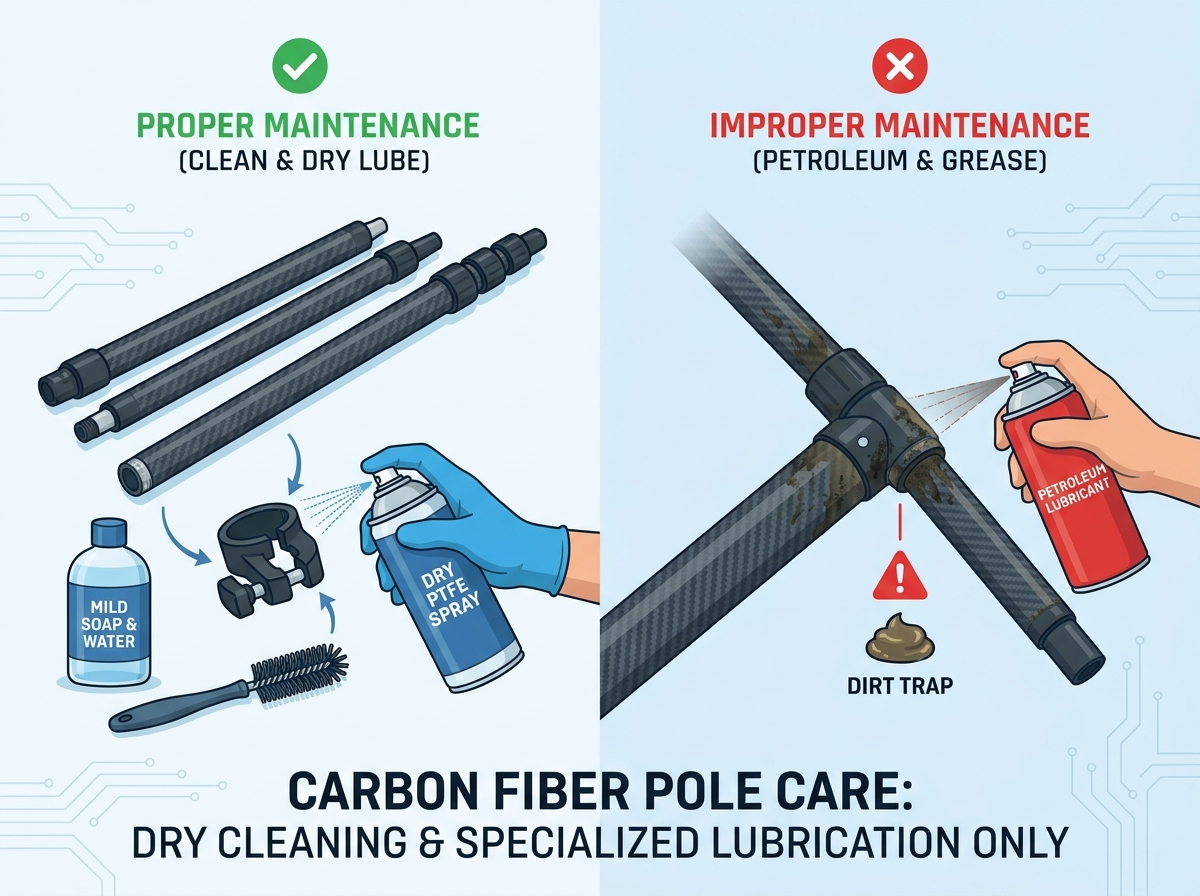
Proper maintenance restores grip and extends equipment life significantly. You must follow strict protocols to protect the delicate resin finish.
Proper Cleaning: Start by completely disassembling every section. Wash every individual piece using warm water. Add a mild, pH-neutral dish soap. Do not use harsh industrial chemicals or bleach. Buy a customized internal bore brush. Run it gently through the female tubes to clear all hidden debris. Rinse each part thoroughly and let them air dry completely. Never reassemble wet components.
Appropriate Lubrication: This step is absolutely critical. Never use WD-40 on your gear. Avoid silicone wet lubes completely. Stay away from standard automotive grease. Wet lubricants degrade the epoxy resin rapidly. They also trap new airborne dirt instantly. We strongly recommend dry graphite powder. You can also use a specialized dry PTFE spray safely. Apply this strictly to the mechanical clamp assembly. Do not spray it directly on the carbon pole surface.
Tension Re-calibration: Systematically tighten the flip-lock bolts after cleaning. Give the tension screw a mere quarter turn. Test the clasp tension immediately. Repeat this micro-adjustment until the clamp feels secure. Never over-torque the bolts under any circumstances. Excessive pressure will permanently crush the hollow carbon tube. This mistake destroys the section entirely.
Following these exact maintenance steps prevents premature aging. It keeps the sliding mechanism feeling smooth and responsive.
Every piece of professional equipment eventually reaches a breaking point. You must decide whether to fix it or buy entirely new gear. Making the wrong choice drains your budget.
The Cost of Downtime: Field failures carry massive hidden costs. A slipping pole might drop expensive photography gear. A stuck joint ruins your daily window cleaning route. Compare these downtime losses directly against the price of new equipment. Usually, reliable gear pays for itself very quickly. Lost client trust costs more than a replacement pole.
Evaluating Modularity: This is where modern engineered designs shine brightly. You should strongly consider investing in modular systems. Systems utilizing replaceable carbon fiber pole sections make excellent business sense. Users can easily swap out a single crushed base. They can replace a worn tip section in mere minutes. These modular units easily outlast sealed, single-unit poles by many years. You only pay for the specific part you broke.
End-of-Life Indicators: Sometimes, basic repair is totally impossible. Look for deep structural gouges penetrating the woven fibers. Check for generally compromised structural integrity across multiple sections. If you have obsolete lock designs, you might not find spare parts anywhere. These are clear signs to replace the entire unit. Stop wasting time fixing dead equipment. Upgrade to modern standards.
When replacing your old gear, buy smartly. Not all poles deliver the same professional performance.
Locking Mechanism Architecture: You must evaluate the clamp design carefully. Lateral flip locks offer easy field maintenance. You can easily see the tension bolt. Internal twist locks look much sleeker. However, they are highly prone to hidden grit jamming.
Locking Mechanism Comparison
Feature | Lateral Flip Locks | Internal Twist Locks |
|---|---|---|
Field Maintenance | Easy, uses basic tools | Difficult, requires full disassembly |
Visual Tension Check | Yes, clearly visible | No, relies on feel |
Jamming Risk | Low (easy to clean) | High (traps unseen grit) |
Profile | Bulky | Slim and aerodynamic |
Versatility & Scalability: Assess the value of highly adaptable equipment. We recommend purchasing multi-functional carbon fiber telescopic rods. These rods accept various standardized industry attachments. You can mount cameras, specialized cleaning brushes, or survey prisms easily. This versatility helps consolidate your overall equipment needs. It also saves valuable truck storage space. You carry one excellent pole instead of three cheap ones.
Vendor Transparency & Parts Supply: Always reject "maintenance-free" claims. Serious professional equipment requires routine maintenance. Trustworthy manufacturers provide detailed exploded parts diagrams. They sell replacement clamps readily. They offer internal replacement shims. They let you buy individual tube sections directly. Buying from reliable vendors protects your initial investment completely. Using premium carbon fiber telescopic poles ensures top-tier performance. Good parts availability keeps them running indefinitely. Do not buy disposable equipment.
Maintaining your structural integrity requires regular attention and care. You must perform routine disassembly and dry cleaning. Treat your equipment well, and it will perform perfectly. When structural fatigue finally sets in, your procurement strategy matters greatly. The most cost-effective path is investing in modular poles. Look for field-serviceable joints. Demand replaceable sections from your manufacturer. Audit your current equipment today. Use our inspection checklist to find dangerous weak points early. If your gear fails these tests, contact a qualified specialist. They can help you spec a scalable, modular carbon fiber system. A tailored system guarantees better safety and higher efficiency.
A: Yes. Avoid twisting with metal tools. Use strap wrenches for even pressure, apply ice to the inner tube (to induce slight shrinkage), and gently tap the joint to break the grit seal.
A: Aluminum bends and dents, which permanently seizes the pole. Carbon fiber flexes and returns to shape, making it structurally superior, though its smoother surface requires lock tension maintenance.
A: On professional-grade models, yes. Look for brands that sell replacement clamps and internal shims rather than forcing a full unit repurchase.


