
English 
+86-157-6313-9515
lina@hezongmaterials.com
lina@hezongmaterials.com
26 Jiashan Road, Chucun Town, Weihai City, Shandong Province, China


Views: 0 Author: Site Editor Publish Time: 2026-08-04 Origin: Site


The transition from wet layup to pre-impregnated composites introduces strict dependencies on material consistency. Supplier selection dictates part yield and mechanical performance. Sourcing prepreg requires deep technical alignment. Engineers and procurement teams must match a supplier’s resin chemistry, fiber architecture, and thermal profiles with specific production environments. You have to align these materials directly with your tooling constraints, vacuum bagging setups, and certification requirements. To minimize scrap rates and ensure structural integrity, organizations must systematically audit potential partners before committing to volume production. This guide details the technical frameworks required to evaluate a carbon fiber prepreg manufacturer across quality control, custom formulation, and supply chain reliability.
Resin-to-Fiber Consistency: Strict tolerance control over Fiber Volume Fraction (FVF) and resin content is the primary indicator of a manufacturer's baseline quality and process maturity.
Customization Capabilities: High-value suppliers can modify tack, drape, and cure cycles—including formulating high temperature carbon fiber prepreg systems—to match specific tooling and end-use applications.
Logistics and Scalability: A viable manufacturing partner must demonstrate robust cold-chain logistics, transparent batch traceability, and the financial stability to scale capacity in a rapidly growing market.
You must establish baseline targets for tensile strength, modulus, interlaminar shear strength, and fatigue resistance. These targets vary significantly based on the final application. Aerospace components demand entirely different failure margins than sporting goods. The absolute necessity here is consistent Fiber Volume Fraction (FVF). You also need precise resin areal weight (RAW) control across every roll. Variations in these metrics cause dry spots or resin-rich zones during the cure cycle. These defects severely compromise the structural integrity of the final composite part. Evaluate the manufacturer's technical support for ply orientation and layup schedules. Proper engineering guidance helps maximize directional mechanical performance. A competent supplier will provide extensive empirical data to support your structural design assumptions.
When evaluating mechanical baselines, engineering teams should follow a strict validation sequence to ensure the material meets structural demands. Skipping these validation steps often leads to catastrophic failures during physical load testing.
Define the exact load paths and stress concentrations for the intended composite structure.
Request historical coupon test data from the supplier for the specific fiber and resin combination.
Verify the supplier's stated interlaminar shear strength (ILSS) values, as this dictates the material's resistance to delamination.
Compare the supplier's fatigue resistance data against your product's expected lifecycle.
Align your material selection directly with your existing manufacturing infrastructure. Determine your requirements for Autoclave versus Out-of-Autoclave (OOA) compatibility. OOA prepregs require specifically engineered resin channels to evacuate air under vacuum pressure alone. Review the required vacuum bagging schedules provided by the supplier. Define acceptable cure cycle times, ramp rates, and thermal management requirements. These parameters must match your in-house tooling thermal mass. Invar tooling heats much slower than aluminum or composite molds. If the resin reacts too quickly, the tool will act as a heat sink, preventing the laminate from reaching the required cure temperature.
Assess your shop floor handling requirements thoroughly. Consider the necessary cutting equipment, cleanroom standards, and debulking intervals recommended by the supplier. Complex geometries often require frequent debulking steps to prevent bridging and void formation. You must understand how long the material can remain at room temperature before the resin advances too far. This out-life dictates your maximum allowable layup time for large or complex structures.
Prepreg Material Evaluation Matrix
Evaluation Category | Critical Metrics | Warning Signs |
|---|---|---|
Resin Chemistry | Tg, Cure Kinetics, Viscosity Profile | Inconsistent tack between batches |
Fiber Architecture | FAW Tolerance, Crimp Angle, Tow Straightness | Visible fuzz balls or broken filaments |
Quality Control | DSC/DMA Data, FVF Consistency | Missing Certificates of Analysis |
Logistics | Cold-Chain Integrity, Out-Life Tracking | Deliveries arriving above -18°C |
Assess the manufacturer's resin portfolio with extreme scrutiny. Look well beyond standard epoxy systems. Investigate their capabilities with advanced matrices like BMI, cyanate ester, PEEK, and thermoplastics. Evaluate their engineering depth in formulating high temperature carbon fiber prepreg designed for extreme thermal environments. Applications like motorsport exhausts or aerospace engine nacelles require specialized chemistry to survive continuous heat exposure. Standard epoxies degrade rapidly under these conditions, losing their mechanical properties and structural integrity.
A highly capable prepreg carbon fiber factory will adjust formulations to prevent premature thermal degradation. They should offer custom resin blending to achieve specific glass transition temperatures (Tg) tailored to your operational environment. The supplier must demonstrate a deep understanding of resin rheology. They need to control how the resin flows during the initial heating ramp before it gels. Proper flow control prevents resin starvation in tight corners and ensures complete wet-out of the fiber bed.
Common Resin Systems and Applications
Matrix Type | Typical Tg Range | Primary Industrial Applications |
|---|---|---|
Standard Epoxy | 120°C - 150°C | Sporting goods, automotive body panels, marine structures |
Toughened Epoxy | 130°C - 180°C | Aerospace primary structures, impact-resistant components |
Bismaleimide (BMI) | 230°C - 280°C | Engine nacelles, high-speed radomes, motorsport exhausts |
Cyanate Ester | 200°C - 250°C | Spacecraft structures, low-outgassing satellite components |
Investigate the availability and quality of Unidirectional (UD) tapes versus woven fabrics. Woven options typically include twill, plain, and harness satin weaves. Each weave pattern offers distinct advantages for drapeability and surface finish. Scrutinize the sourcing of precursor materials and tow sizes. Tow sizes generally range from 3K to 50K. The chosen tow size has a direct impact on drapeability and structural integrity. Heavy 50K tows build thickness rapidly for industrial applications. However, they struggle to conform to complex, tight-radius contours. Lighter 3K fabrics provide excellent cosmetic finishes and easily drape over complex mold geometries.
Ensure the supplier maintains strict tension control during the weaving process to minimize fiber crimp. Excessive crimp reduces the compressive strength of the final laminate because the fibers are not perfectly straight. The manufacturer must also control the sizing applied to the raw carbon fiber. The sizing must be chemically compatible with the chosen resin system to ensure a strong interfacial bond between the fiber and the matrix.
Manufacturers adjust resin rheology and B-stage curing to meet specific layup requirements. This customization is vital for production efficiency. The trade-offs involved in balancing material tackiness for complex mold geometries require precise chemical control. High tack helps plies adhere to vertical mold faces during layup. However, excessive tack can trap air between plies and complicate the debulking process. Operators will struggle to reposition plies if the material is too sticky.
Suppliers must balance tack and drape without sacrificing out-life or shelf life. A well-formulated prepreg maintains consistent handling characteristics throughout its stated out-life. Ask the supplier how they modify resin viscosity profiles to control resin flow during the initial heating ramp. Proper flow control prevents resin starvation in tight corners. If the resin viscosity drops too low during the cure cycle, it will bleed out of the laminate, leaving dry fibers behind.
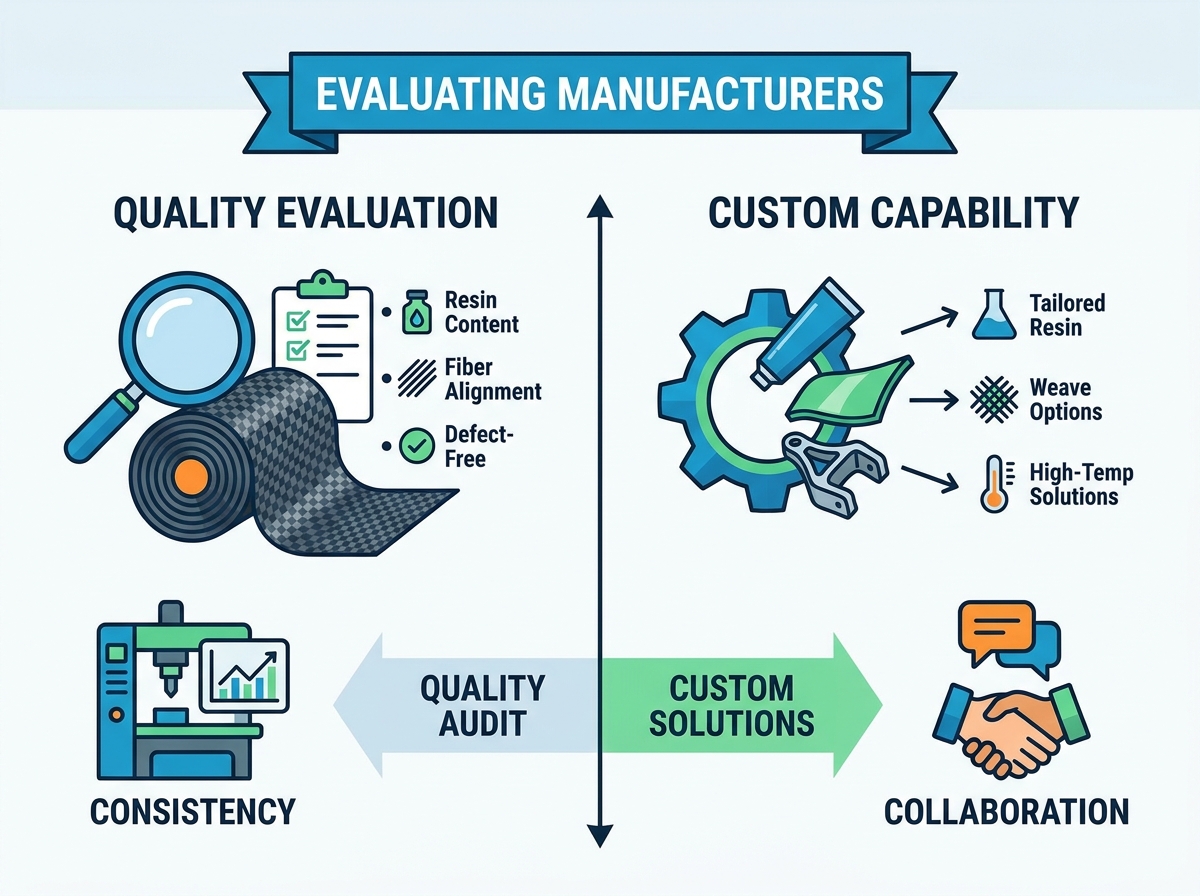
Verification of the manufacturer’s internal testing standards is non-negotiable. Demand strict ASTM or ISO compliance for tensile, compression, and fatigue testing on cured coupons. The supplier must utilize Differential Scanning Calorimetry (DSC) and Dynamic Mechanical Analysis (DMA) for every batch. These instruments verify cure kinetics and exact glass transition temperature (Tg). DSC measures heat flow to identify exothermic peaks and confirm the degree of cure. DMA measures the storage modulus to pinpoint the exact temperature where the material softens.
Without this thermal data, you risk catastrophic curing failures on your shop floor. Relying on generic data sheets instead of batch-specific testing introduces unacceptable risk into your production line. You must know exactly how the specific batch of material will behave under heat and pressure. The manufacturer should provide a detailed thermal profile showing the optimal ramp rates and dwell times for their specific resin formulation.
Implementation of automated optical inspection (AOI) during the impregnation process is a strong indicator of quality. High-resolution cameras and sensors detect dry spots, fuzz balls, or foreign object debris (FOD). FOD inclusion is a primary cause of interlaminar shear failure in composite structures. Establish strict requirements for batch-to-batch traceability. The supplier must provide comprehensive Certificates of Analysis (CoA) with every single shipment. This documentation proves the material meets your exact Fiber Areal Weight (FAW) and Resin Areal Weight (RAW) specifications.
Review their procedures for quarantining and rejecting non-conforming master rolls before they reach the slitting and packaging phase. A robust quality control system catches defects before the material leaves the factory. Ask to see their defect logs and corrective action reports. This transparency shows how the manufacturer handles internal failures and improves their processes over time.
Defect Types and Root Causes
Defect Type | Visual Indicator | Manufacturing Root Cause |
|---|---|---|
Dry Spots | Uncoated, dull fiber patches | Insufficient resin filming pressure or low resin content |
Fuzz Balls | Clumps of broken filaments | Excessive tension or friction during the weaving process |
Resin Rich Zones | Glossy, thick pools of resin | Uneven compaction roller pressure during impregnation |
Foreign Object Debris | Embedded particles or backing paper | Poor cleanroom standards or inadequate AOI systems |
Auditing the facility for critical quality management systems provides a baseline for trust. Key certifications include AS9100 for Aerospace, IATF 16949 for Automotive, and ISO 9001 for general industrial manufacturing. These certifications dictate strict process controls and continuous improvement mandates. Ensure the factory maintains rigorous documentation to support end-user regulatory compliance. Traceability audits require you to track a finished composite part back to the specific batch of precursor PAN fiber.
The manufacturer's ERP system must support this level of granular traceability. Ask to see their internal audit reports and corrective action logs during your facility visit. You need to verify that their calibration records for testing equipment are up to date. An expired calibration on a DSC machine renders all thermal data invalid, putting your entire production run at risk.
Auditing the manufacturer's infrastructure for sub-zero storage is mandatory. Prepreg materials typically require continuous storage at -18°C to halt the resin curing process. Temperature-controlled shipping logistics are equally vital to material survival. Calculate out-life versus shelf-life trade-offs based on your specific geographic location. Factor in shipping routes, customs delays, and your shop floor environment. A broken cold chain ruins material chemistry and causes the resin to advance prematurely.
This premature advancement reduces tack, stiffens the drape, and prevents proper consolidation during the cure cycle. Mandate the use of temperature data loggers in every shipment to verify cold-chain integrity from their dock to yours. If a shipment arrives and the data logger shows a temperature spike, you must have a clear contractual agreement on how the supplier will replace the compromised material.
Navigating the financial and operational transition from R&D sampling to full-scale manufacturing requires clear communication. Short rolls are necessary for initial layup trials and process validation. Clarify how MOQs scale as you move into volume production. Assess lead time reliability and the supplier's surge capacity. Investigate the manufacturer's own raw material supply chain stability. If they cannot secure consistent allocations of raw carbon fiber tow or base resins, your production line will eventually stop.
Discuss their inventory buffering strategies. A reliable partner holds safety stock of your specific resin film and fabric to absorb unexpected spikes in your demand. You should also establish clear communication channels for forecasting. Providing the supplier with accurate quarterly forecasts allows them to secure raw materials in advance, protecting you from global supply chain shortages.
Evaluating the supplier's long-term viability is a strategic necessity. Review their capital investment strategy in response to the rapidly expanding global composites market. Prepreg manufacturing requires massive capital expenditure for creels, resin filmers, compaction rollers, and accumulators. Ensure the manufacturer has the physical infrastructure and financial backing to scale production lines. They must be able to increase capacity without introducing supply bottlenecks.
Rapid scaling often degrades material consistency if the manufacturer lacks automated process controls. Ask about their equipment redundancy. If their primary impregnation line goes down for maintenance, they must have a backup line to fulfill your orders. A single point of failure in their manufacturing facility translates directly to a single point of failure in your supply chain.
The most significant risk is the prepreg failing to meet stringent aerospace or automotive certification standards. This usually happens during the First Article Inspection (FAI) phase. Mitigate this risk by mandating pilot-scale production runs before signing long-term contracts. Request extensive historical test data for the specific resin system you plan to use. Conduct independent third-party coupon testing to verify the manufacturer's internal data.
Build a comprehensive test matrix that includes hot/wet conditioning. Composites often perform perfectly at room temperature but fail mechanical tests after absorbing moisture and facing elevated temperatures. Do not commit to volume orders until the FAI is fully approved. You must also establish a clear protocol for handling material deviations. If a batch falls slightly outside the specification limits, you need a predefined process to determine if the material is usable or must be scrapped.
A mismatch between the manufacturer's recommended cure cycle and your tooling capabilities creates severe processing risks. This mismatch leads to uncontrolled exotherms or incomplete cures. Epoxy resins release significant heat as they crosslink. In thick composite parts, the center of the laminate insulates this heat. This causes temperature spikes that can literally burn the resin or catch fire. Mitigate this through collaborative thermal profiling prior to purchase.
Request modified resin formulations tailored to your specific ramp rates and part thicknesses. Implement step-curing profiles to manage the exothermic reaction safely. Use embedded thermocouples during initial trials to map the thermal gradient across your tool. You must ensure the entire part reaches the required cure temperature simultaneously. Uneven heating causes residual thermal stresses, leading to part warpage and dimensional inaccuracies after demolding.
Request Technical Data Sheets (TDS) and Material Safety Data Sheets (MSDS) from shortlisted suppliers to verify baseline chemistry.
Order sample rolls for in-house layup and cure trials to evaluate tack, drape, and out-life in your specific shop environment.
Schedule a comprehensive facility audit to verify their cold-chain capabilities and automated optical inspection systems.
Conduct collaborative thermal profiling with the supplier to match their recommended cure cycles with your existing tooling thermal mass.
A: Standard shelf life is typically 6 to 12 months when stored continuously at -18°C (0°F). Manufacturers extend this by formulating latent curing agents that only activate at specific elevated temperatures. Maintaining an unbroken cold chain during transit and storage is the only practical way to preserve the stated shelf life.
A: You need commercial walk-in freezers capable of maintaining -18°C for storage. For handling, you need automated CNC cutting tables to prevent fiber distortion, cleanrooms with strict temperature and humidity controls to maximize out-life, and vacuum bagging consumables for debulking and curing preparation.
A: You verify quality and Glass Transition Temperature (Tg) by requesting batch-specific Dynamic Mechanical Analysis (DMA) and Differential Scanning Calorimetry (DSC) reports from the manufacturer. You should also cure test coupons in-house and send them to a third-party laboratory for independent DMA verification.
A: Autoclave prepregs rely on high external pressure (typically 45-100 psi) to crush voids and consolidate plies. OOA prepregs are engineered with specific dry fiber channels that allow trapped air and volatiles to escape under standard atmospheric vacuum pressure, eliminating the need for expensive autoclave equipment.
A: Yes. Manufacturers customize tack and drape by adjusting the resin's molecular weight, modifying the B-stage partial cure process, or adding specific tackifiers. They also alter the fiber weave style and tow size to improve the fabric's ability to conform to complex, tight-radius mold geometries.
A: You must request a Certificate of Analysis (CoA) for every batch, detailing Resin Content, Fiber Areal Weight (FAW), and Volatile Content. Additionally, request their AS9100 or ISO 9001 certification, DSC/DMA thermal analysis reports, and the temperature data logger history from the shipping container.


