
English 
+86-157-6313-9515
lina@hezongmaterials.com
lina@hezongmaterials.com
26 Jiashan Road, Chucun Town, Weihai City, Shandong Province, China


Views: 0 Author: Site Editor Publish Time: 2026-07-16 Origin: Site


Designing drone arms presents a strict engineering challenge: balancing structural mass, motor efficiency, and overall flight time. Every gram added to the airframe directly reduces payload capacity and shortens battery life. Removing too much material compromises rigidity. This lack of stiffness leads to flight controller oscillation, poor yaw authority, and potential structural failure during high-stress maneuvers.
Engineers must evaluate materials to resolve this tension. The choice typically comes down to two industry standards: carbon fiber composites and aerospace-grade aluminum. Each material presents distinct mechanical properties, assembly requirements, and implementation realities for commercial UAV manufacturing. You must analyze specific modulus, vibration dampening, and assembly complexity to optimize your next drone build for performance and reliability.
Specific Modulus Superiority: A high-quality carbon fiber tube offers a significantly higher stiffness-to-weight ratio than aluminum, directly translating to increased payload capacity and extended battery life.
Vibration Dampening: The composite matrix of carbon fiber naturally attenuates high-frequency motor vibrations better than aluminum, reducing noise in IMU/gyro sensor data.
Assembly Complexity: Aluminum supports traditional machining, tapping, and threading; carbon fiber requires specialized clamping mechanisms, adhesive bonding, or compression inserts to prevent structural delamination.
Galvanic Corrosion Risk: Direct contact between carbon fiber and aluminum creates a galvanic couple, requiring non-conductive isolation barriers in hybrid assemblies.
Cost vs. Performance: While aluminum lowers prototyping and raw material costs, lightweight carbon fiber tubing for drones is the mandatory standard for enterprise, heavy-lift, and endurance-focused UAV platforms.
Drone arms act as rigid booms resisting bending moments generated by motor thrust. Materials require a high specific modulus to maintain structural integrity without adding parasitic mass. Excessive weight directly degrades flight performance. The stiffness-to-weight ratio remains the primary metric for evaluating arm materials. When a drone accelerates, the arms must not flex. Flexing alters the thrust vector, forcing the flight controller to compensate constantly. This compensation drains the battery faster and reduces overall flight stability.
Rapid yaw maneuvers subject drone arms to significant torsional loads. Motor torque twists the arm, demanding materials with an exceptional shear modulus. High torsional rigidity ensures precise control. It prevents unwanted deflection that confuses the flight controller. If an arm twists during a hard yaw input, the motor angle changes relative to the frame. This introduces cross-coupling errors into the flight dynamics. You need a material that resists this twisting force entirely.
Frame resonance severely impacts flight controller performance. High-frequency motor vibrations transmit through the arms, introducing noise into IMU and gyro sensor data. Materials that naturally dampen these vibrations improve flight stability. They reduce the need for aggressive software filtering. Heavy software filtering introduces latency into the control loop. Lower latency means a more locked-in flight feel. Natural material dampening is always superior to software-based notch filtering.
Drone arms endure cyclic loading from continuous flight operations and sudden impact forces. Materials handle these stresses differently. Some undergo plastic deformation, bending before breaking. Others suffer catastrophic fracture. High fatigue resistance is essential for long-term reliability in commercial operations. Propeller wash creates constant micro-vibrations. Over hundreds of flight hours, these vibrations can cause micro-cracking in inferior materials. You must select a material that withstands this continuous cyclic stress without degrading.
UAVs operate in diverse environments, requiring materials with specific thermal and chemical properties. Low thermal expansion coefficients maintain dimensional stability across temperature extremes. Resistance to UV degradation and atmospheric corrosion is vital for drones used in coastal or agricultural settings. Salt spray from ocean environments rapidly attacks unprotected metals. Agricultural chemicals can degrade certain epoxies. The chosen material must survive the specific operational environment without losing structural integrity.
A carbon fiber tube exhibits anisotropic strength. Its mechanical properties vary by direction based on the fiber layup. Roll-wrapped tubes are ideal for drone arms because they handle multi-directional torsional and bending loads effectively. Pultruded tubes, strong only in axial tension and compression, often split under the twisting forces generated by drone motors. You must specify roll-wrapped construction for any multirotor arm application to ensure torsional stability.
The structural characteristics of carbon fiber depend heavily on the layup. A 3K twill weave offers excellent conformability and multi-directional strength. Plain weave provides tighter interlacing but less conformability. Fiber orientation angle dictates hoop strength and bending stiffness. Engineers tailor the tube's properties to specific load requirements by adjusting the layup schedule. A common schedule might include unidirectional layers for bending stiffness, wrapped with a 3K twill outer layer for hoop strength and impact resistance.
Transitioning to lightweight carbon fiber tubing for drones yields substantial performance gains in multirotor design. Replacing heavier materials reduces frame weight significantly. This mass reduction directly increases hover time, improves agility, and expands payload capacity for cameras or sensors. Every gram saved on the frame can be allocated to a larger battery or a heavier sensor payload. This directly impacts the operational capability of the aircraft.
Carbon fiber is electrically conductive. It blocks, reflects, or attenuates RF signals. This characteristic necessitates careful component placement. GPS, telemetry, and receiver antennas must be positioned away from the tubes. You often need extended masts to prevent signal degradation and ensure reliable communication. Mounting a GPS puck directly on a carbon plate will severely degrade satellite reception. You must plan your avionics layout to account for this RF shielding effect.
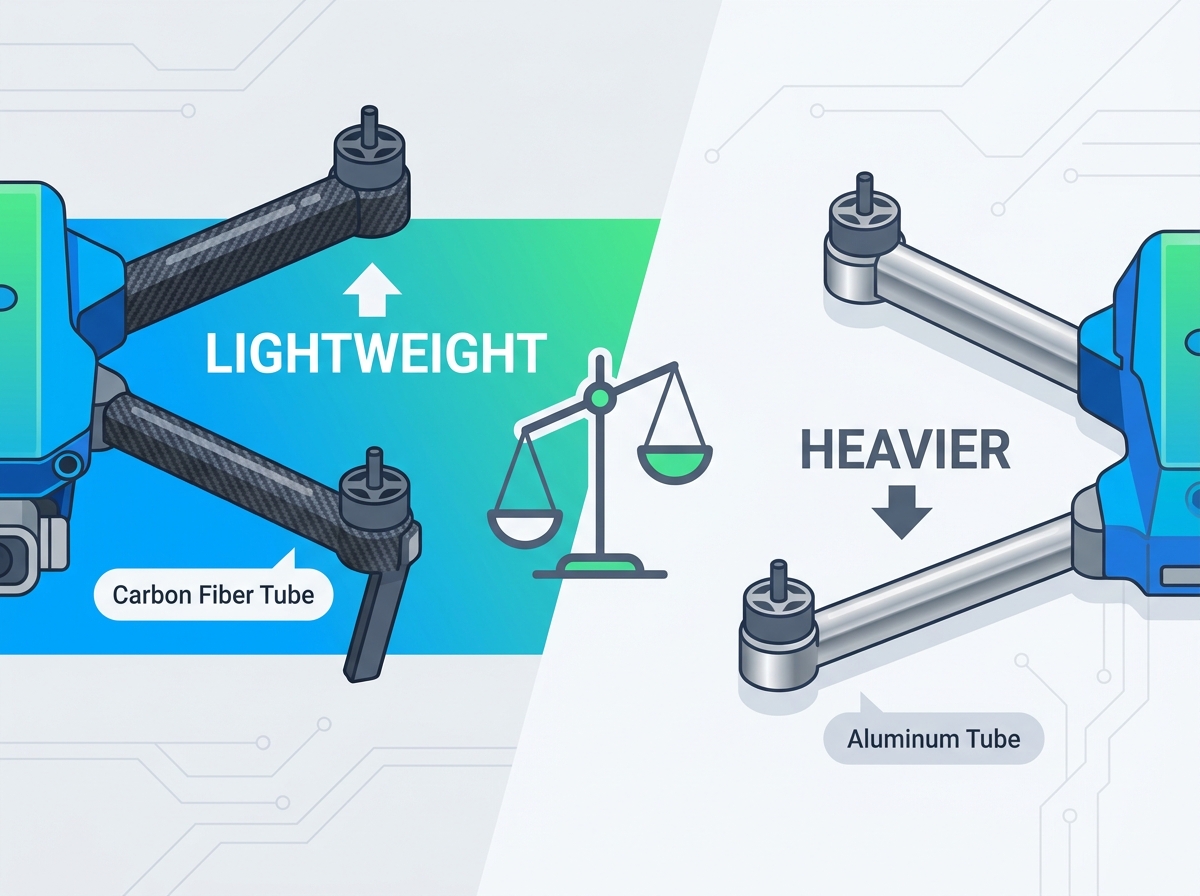
Aluminum offers isotropic strength, providing uniform mechanical properties in all directions. 6061-T6 aluminum is highly machinable, weldable, and corrosion-resistant. 7075-T6, an aircraft-grade alloy, delivers higher tensile strength but has lower fatigue limits and is more challenging to work with. When designing with aluminum, you don't need to worry about fiber orientation. The material behaves predictably regardless of the load direction. This simplifies the engineering analysis and simulation process.
Aluminum acts as a natural heat sink. Its high thermal conductivity draws thermal loads away from high-KV brushless motors during sustained high-current draws. This passive cooling effect helps maintain optimal motor operating temperatures. It extends component lifespan in demanding applications. Heat is the enemy of brushless motor efficiency. By sinking heat into the aluminum arm, you keep the stator windings cooler, which maintains motor efficiency during heavy lift operations.
Aluminum tubing simplifies assembly. It allows for easy drilling, tapping threads, and the use of standard fasteners. Engineers mount components directly to the tube without risking structural integrity or requiring specialized composite tooling. This significantly reduces fabrication time. You can tap an M3 thread directly into a thick-walled aluminum tube. This eliminates the need for complex clamping mechanisms or bonded inserts, streamlining the manufacturing process.
Anodizing aluminum increases surface hardness and prevents oxidation. This electrochemical process provides electrical insulation for the drone frame, reducing the risk of short circuits. Anodized finishes improve durability and offer aesthetic customization options for commercial fleets. Type III hardcoat anodizing provides a highly wear-resistant surface. This protects the aluminum from scratches and minor impacts during field operations. It also prevents the raw aluminum from oxidizing in humid environments.
Consider a standard drone arm measuring 25mm OD, 23mm ID, and 500mm in length. An aluminum tube of these dimensions weighs significantly more than a comparable carbon fiber tube. This weight delta directly impacts the thrust-to-weight ratio. It limits the payload capacity of aluminum-framed drones compared to carbon fiber alternatives. To achieve the same flight time with an aluminum frame, you need larger motors and a larger battery, which further increases the total takeoff weight.
| Material Property | Carbon Fiber (Roll-Wrapped) | Aluminum (6061-T6) |
|---|---|---|
| Density (g/cm³) | 1.5 - 1.6 | 2.70 |
| Tensile Strength (MPa) | 600 - 1000+ | 310 |
| Vibration Dampening | Excellent | Poor |
| Machinability | Requires specialized tooling | Excellent (Drill/Tap) |
Extruded or drawn aluminum tubing maintains tight OD and ID tolerances, ensuring precise fitment. Roll-wrapped carbon fiber tubes may exhibit slight OD variances due to the manufacturing process. Achieving a perfect slip-fit with precision CNC clamps often requires light sanding of the carbon fiber surface. If a carbon tube is slightly oversized, forcing it into a rigid aluminum clamp can crush the fibers. You must measure each tube and match it to the appropriate clamp.
Aluminum transmits acoustic and vibratory energy more readily than carbon fiber. The composite matrix of carbon fiber naturally dampens high-frequency motor vibrations. Consequently, aluminum arms often require additional soft-mounting solutions for motors or flight controllers to prevent vibration-induced sensor errors. Without soft mounting, the gyro will read the motor noise as physical movement. This causes the flight controller to send erratic signals to the ESCs, resulting in hot motors and poor flight performance.
Aluminum absorbs energy through plastic deformation. It tends to bend or dent upon impact, allowing for visual inspection and potential emergency landings. Carbon fiber tends to shatter or delaminate catastrophically when loads exceed its ultimate tensile strength. It offers little warning before complete structural failure. A bent aluminum arm can often be bent back into shape for a temporary field repair. A shattered carbon arm requires complete replacement before the aircraft can fly again.
Drilling through-holes in a carbon fiber tube for motor mounts is highly discouraged. This severs continuous fibers, creates critical stress risers, and leads to progressive inter-laminar shear failure. Engineers must use alternative mounting methods to preserve the tube's structural integrity. If you must drill, you need specialized diamond-coated drill bits and high RPMs to minimize fiber tear-out. Even then, the structural integrity of the tube is permanently compromised at that location.
Never use standard high-speed steel (HSS) drill bits on carbon composites.
Always support the back side of the hole to prevent exit splintering.
Seal any drilled holes with thin CA glue or epoxy to prevent moisture ingress.
Prefer compression clamps over through-hole bolting whenever possible.
Direct contact between carbon fiber and aluminum creates a galvanic couple in the presence of moisture. This chemical reaction causes rapid corrosion of the aluminum. Prevention requires non-conductive isolation barriers. You must use fiberglass scrim, epoxy interfaces, or nylon washers to separate the materials. If you bolt a raw aluminum motor mount directly to a carbon tube and fly in a humid environment, the aluminum will pit and degrade rapidly. Always isolate the two materials.
Fastening hardware differs significantly between materials. Aluminum supports simple drilled-and-tapped solutions. Carbon fiber requires friction-based compression clamps, epoxy-bonded aluminum inserts, or custom CNC motor mounts. These distribute clamping forces evenly and prevent crushing the tube. Over-tightening a clamp on a carbon tube will cause inter-laminar shear failure. You must use a torque wrench and adhere to strict torque specifications when assembling carbon fiber frames.
Aluminum offers lower raw material costs and faster assembly times for low-volume prototyping. Machining carbon fiber causes rapid tool wear due to highly abrasive carbon dust. For high-volume production where performance is paramount, the benefits of carbon fiber often justify the higher manufacturing costs. You must factor in the cost of specialized dust extraction equipment and carbide tooling when setting up a production line for carbon fiber components.
Specify carbon fiber for applications where weight savings and stiffness are critical. Ideal use cases include heavy-lift cinematography, agricultural spraying, long-endurance mapping, and FPV racing. In these scenarios, the performance gains justify the premium cost and assembly complexity of high-modulus composites. If your drone needs to fly for more than 45 minutes or carry a payload exceeding 5 kilograms, carbon fiber is the only viable structural material.
Choose aluminum for rapid prototyping, budget-constrained commercial fleets, and training drones. It is also suitable for underwater ROVs or environments requiring high impact survivability. The ability to bend rather than shatter provides a distinct operational advantage in these specific use cases. If you are building a fleet of training drones that will crash frequently, aluminum arms are cheaper to replace and easier to inspect for damage.
Many engineers adopt a hybrid approach to leverage the strengths of both materials. This involves using lightweight carbon fiber tubing for drones for the primary structural boom, paired with CNC-machined aluminum motor mounts and frame clamps. This method balances stiffness, weight reduction, and secure component mounting. The aluminum clamps provide a secure mounting interface, while the carbon tube provides the necessary stiffness and weight savings.
Carbon fiber and aluminum each offer distinct advantages for drone arm construction. Roll-wrapped carbon fiber tubes provide a superior stiffness-to-weight ratio and better vibration damping, making them suitable for endurance, heavy-lift, racing, and payload-sensitive UAVs. Aluminum is heavier but offers easier machining, simpler fastening, predictable material behavior, and more visible impact damage, which can benefit prototypes, training drones, and cost-sensitive fleets.
The final choice should reflect the required payload, flight time, operating environment, production volume, and maintenance needs rather than material weight alone. Hybrid structures can combine carbon fiber booms with aluminum mounts, provided the materials are electrically isolated to prevent galvanic corrosion.
Before full production, engineers should verify material data, dimensional tolerances, clamp fit, vibration behavior, and structural performance through sample testing under realistic flight loads.
A: Drilling holes severs continuous fibers and creates stress risers, significantly weakening the structure. Use friction-based compression clamping mechanisms instead to mount components without damaging the tube.
A: Yes, carbon fiber is electrically conductive and can block, reflect, or attenuate RF signals. Antennas must be isolated on extended masts away from the carbon frame to maintain reliable communication.
A: Roll-wrapped tubes feature multi-directional fibers, handling torsional and bending forces effectively. Pultruded tubes only have axial fibers and split easily under the twisting loads generated by drone motors.
A: Wrap the cut area tightly in masking tape and use an abrasive diamond-grit rotary blade. Always wear respiratory PPE to avoid inhaling toxic, highly abrasive carbon dust during the cutting process.
A: No. Aluminum has a density of approximately 2.81 g/cm³, while carbon fiber composites range from 1.5 to 1.8 g/cm³. Carbon fiber offers a vastly superior specific strength and stiffness-to-weight ratio.
A: Use non-conductive isolation barriers between the materials. Effective solutions include fiberglass sleeves, structural epoxy layers, delrin shims, or passivated titanium hardware to break the electrical connection.
A: Thicker walls increase impact resistance and rigidity but add weight. Thinner walls maximize weight savings for endurance flights but are more susceptible to crushing forces from clamps.


