
English 
+86-157-6313-9515
lina@hezongmaterials.com
lina@hezongmaterials.com
26 Jiashan Road, Chucun Town, Weihai City, Shandong Province, China


Views: 0 Author: Site Editor Publish Time: 2026-09-01 Origin: Site


Traditional wet layup processes introduce inherent variability into composite manufacturing. High void contents, inconsistent resin distribution, and unpredictable mechanical properties plague manual lamination techniques. Modern aerospace, automotive, and high-performance sporting goods require strict tolerances that manual methods simply cannot meet. Engineering teams must achieve exact resin-to-fiber ratios. They need repeatable structural performance and minimized weight. These metrics are impossible to guarantee without standardized, pre-impregnated materials.
Understanding the precise manufacturing workflow allows procurement and engineering teams to evaluate material quality accurately. It helps production managers assess supplier capabilities and maintain strict quality control standards. It also guides the selection of the correct resin system for specific tooling and curing constraints. This technical guide breaks down the entire production cycle. You will learn how raw carbon filaments and formulated resin systems transform into high-performance composite materials ready for precision layup.
Precision is Engineered Upstream: The primary value of prepreg carbon fiber lies in the highly controlled impregnation process, which dictates the exact resin content and mechanical properties of the final composite.
Storage and Handling Dictate Viability: Prepreg systems are suspended in a "B-stage" partial cure, requiring strict cold-storage logistics and careful management of out-time to prevent premature cross-linking.
Curing Infrastructure Drives Selection: The choice between traditional autoclave prepregs and Out-of-Autoclave (OOA) systems fundamentally alters capital equipment requirements, tooling costs, and production scalability.
Defect Mitigation Requires Rigor: Successful implementation relies on precise mold preparation, strategic debulking, hermetic vacuum bagging, and thermal management to prevent voids and exothermic degradation during the final cure.
Prepreg stands for pre-impregnated. In a technical composite context, it refers to reinforcement fibers pre-loaded with a thermoset or thermoplastic resin matrix. The manufacturer mixes the resin and hardener, applies it to the fibers, and then manipulates the temperature to partially cure the matrix. This intermediate state is known as the B-stage. At the B-stage, the material is solid enough to handle but retains enough chemical reactivity to cross-link fully when subjected to final curing temperatures. This eliminates the need for technicians to mix and apply liquid resins on the shop floor.
The B-stage is a highly engineered suspension of chemical activity. If the resin is too cured during manufacturing, it becomes stiff, boardy, and impossible to lay up in complex molds. If it is under-cured, it remains a liquid mess that bleeds out during vacuum bagging, starving the final part of resin. Achieving the exact B-stage requires precise thermal management on the production line.
High-quality materials must meet strict baseline expectations before they ever reach a mold. Uniform fiber alignment is non-negotiable. Any deviation or waviness in the tow directly compromises the load-bearing capacity of the final part. Buyers must inspect rolls for zero dry spots, ensuring the resin has fully penetrated the fiber bundles. Consistent tack, or stickiness, determines how well the material adheres to the mold and subsequent layers during layup. Verified drape measures the material's flexibility. High drape allows the material to conform to complex, compound curves without wrinkling or bridging.
The system relies on three distinct raw inputs. First is the carbon fiber tow. Manufacturers typically use 3K or 12K filaments. A 3K tow contains 3,000 individual carbon filaments, offering a tight weave ideal for cosmetic finishes and intricate geometries. A 12K tow builds structural thickness rapidly. Second is the resin matrix. Epoxy remains the standard for general high-performance applications. Bismaleimide (BMI) and cyanate ester resins are utilized for extreme high-temperature environments. Finally, protective backing paper or polyethylene film covers one or both sides of the roll. This prevents the material from adhering to itself during storage and transit.
Resin Type | Primary Characteristics | Typical Applications |
|---|---|---|
Standard Epoxy | Excellent mechanical properties, good adhesion, moderate temperature resistance. | Sporting goods, automotive panels, general structural components. |
Toughened Epoxy | High impact resistance, formulated with thermoplastic modifiers to prevent micro-cracking. | Aerospace primary structures, crash structures, high-stress components. |
Bismaleimide (BMI) | Exceptional high-temperature performance, maintains strength above 200°C. | Engine nacelles, high-speed aircraft components, exhaust areas. |
Cyanate Ester | Low moisture absorption, excellent dielectric properties, high dimensional stability. | Spacecraft structures, radomes, satellite components. |
The manufacturing process begins at the creel. Multiple bobbins of raw carbon fiber are mounted on a massive rack system. Each bobbin supplies a single tow of carbon fiber. The tows are aligned and pulled through a tensioning system. Precise tension control ensures uniform filament spreading across the entire width of the web. If a single tow sags, the final roll will suffer from dry streaks or structural weak points. Load cells and dancer rollers constantly monitor and adjust the tension of each individual tow before it reaches the resin bath.
Manufacturers process these fibers in two primary formats. Unidirectional (UD) formats align all fibers in a single parallel direction. UD formats provide maximum tensile strength along that specific axis. Engineers stack multiple UD layers at different angles to build tailored load paths. Alternatively, woven fabrics interlace the tows. Twill and plain weaves sacrifice some absolute strength but offer superior drape for complex geometries and provide multi-directional stability.
Resin chemistry dictates the operational limits of the final composite part. Chemists formulate resins specifically for the impregnation machinery. The viscosity must be low enough to penetrate the microscopic spaces between carbon filaments when heated, but high enough to remain stable at room temperature. The formulation process involves blending the base resin with specific curing agents in massive, temperature-controlled mixing vessels. The mixture is then run through a degassing chamber to remove any entrapped air bubbles introduced during mixing.
Additives modify the baseline chemistry to meet strict end-use compliance. Tougheners, such as thermoplastic particles or elastomer modifiers, increase the impact resistance of brittle epoxies. Flame retardants are mandatory for interior components. For example, materials destined for aircraft cabins must pass stringent FAR 25.853 flammability testing. Glass Transition Temperature (Tg) serves as a primary evaluation dimension. Tg defines the temperature at which the cured resin transitions from a rigid solid to a softened, rubbery state. Engineers must select a resin formulation with a Tg that exceeds the maximum operating temperature of the final product.
Base Resin Selection: Choosing the primary polymer (e.g., DGEBA epoxy) based on required mechanical strength.
Hardener Addition: Integrating the curing agent (e.g., amines or anhydrides) to dictate the cure kinetics and out-time.
Modifier Integration: Blending in toughening particles or flame retardants to meet specific industry certifications.
Degassing: Pulling a hard vacuum on the mixed resin to extract microscopic air bubbles before filming.
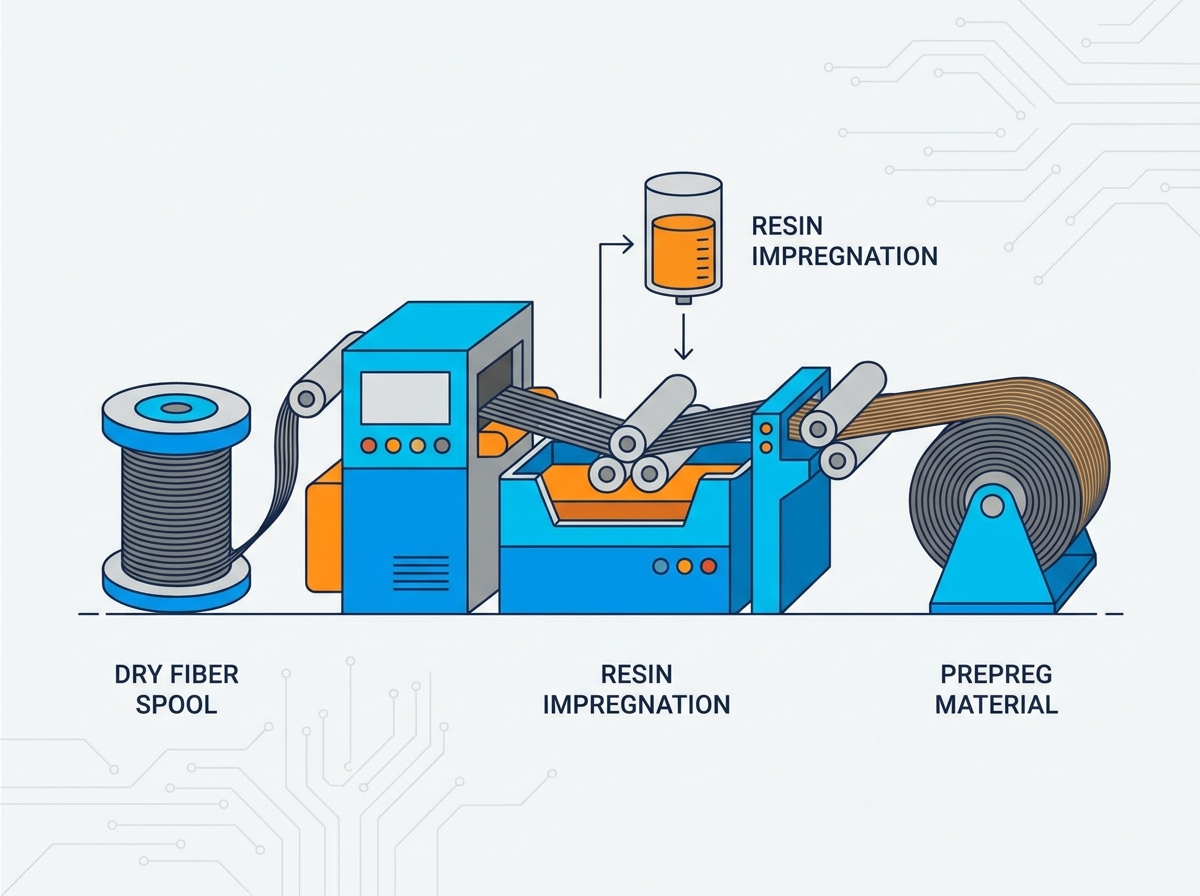
Hot melt impregnation dominates modern composite production due to its precision and environmental safety. This is a highly controlled, two-stage mechanical process. First, the formulated resin is heated to lower its viscosity. A precision doctor blade extrudes the liquid resin onto a continuous roll of silicone-coated release paper, creating a uniform resin film. The thickness of this film is calibrated down to the micron. Beta gauge scanners continuously measure the film weight to ensure absolute consistency across the width of the paper.
In the second stage, the dry carbon fiber web meets the resin film. The combined layers pass through a series of heated nip rollers. The heat temporarily thins the resin, while the mechanical pressure forces it deep into the interstitial spaces of the carbon fiber tows. Temperature and pressure controls dictate the exact resin-to-fiber ratio. Structural components typically target 35-45% resin by weight. Understanding exactly how to make carbon fiber prepreg requires mastering these precise thermodynamic controls to prevent dry spots and ensure complete filament wet-out.
Certain high-temperature resins, like specific polyimides or BMIs, possess viscosities too high for the hot melt process. Manufacturers utilize solvent dip impregnation for these specialized applications. The dry carbon fibers pass directly through a bath of resin that has been thinned with a chemical solvent. The solvent drastically lowers the viscosity, allowing complete saturation of heavy woven fabrics.
After the bath, the saturated web travels through a vertical evaporation oven. The heat flashes off the solvent, leaving only the resin matrix behind. Trade-offs exist with this method. While it achieves better penetration for highly viscous resins, it introduces environmental hazards. Furthermore, if the evaporation process is incomplete, residual trapped solvents will boil during the final part cure, creating catastrophic voids in the laminate.
Feature | Hot Melt Impregnation | Solvent Dip Impregnation |
|---|---|---|
Primary Use Case | Standard epoxies, structural UD, aerospace | High-temp resins, heavy woven fabrics |
Resin Viscosity | Low to medium (heated) | High (thinned with solvent) |
Environmental Impact | Low (no VOCs released) | High (requires solvent recovery systems) |
Void Risk | Low | Moderate (risk of trapped solvent) |
Advanced prepreg manufacturing relies on continuous, inline quality control. Human inspection alone cannot guarantee aerospace tolerances. Laser measurement systems scan the moving web to verify uniform thickness. Automated optical inspection (AOI) cameras detect fiber distortion, fuzz balls, or foreign object debris. Continuous weighing systems calculate the aerial weight (grams per square meter, or gsm) in real-time. If the resin content drifts by even one percent, the machinery automatically adjusts roller pressure to correct the deviation.
The moment the resin fully impregnates the carbon fiber, the chemical clock begins ticking. To prevent the thermoset resin from hardening into a useless solid on the roll, the manufacturing line utilizes rapid chilling. Immediately after exiting the heated nip rollers, the web passes over chilled cooling plates. This sudden drop in temperature halts the chemical cross-linking of the resin. The material enters the B-stage, locking the resin and fibers together in a flexible, tacky state.
The chilled material is then spooled onto cardboard cores. During this spooling process, a protective polyethylene film is applied to the exposed side of the material. This prevents the tacky resin from adhering to the back of the release paper on the adjacent wrap. Tension control during spooling is strictly monitored. Wrapping the roll too tightly forces resin to migrate outwards, altering the precise resin-to-fiber ratio engineered during the hot melt phase. The finished rolls are immediately sealed inside heavy-duty moisture-barrier bags.
Once manufactured, logistics dictate the material's viability. Engineers must track two distinct timelines: out-time and shelf-life. Out-time defines the working life of the material at room temperature. Depending on the resin chemistry, out-time ranges from a few days to several weeks. Once the out-time expires, the resin becomes too stiff to drape and will not consolidate properly during curing.
Shelf-life represents the storage life inside a commercial freezer, typically maintained at -18°C (0°F). Freezing the material extends its viability to 12 or 18 months. Mitigation strategies for handling condensation are mandatory. When retrieving a roll from cold storage, technicians must follow strict thawing protocols.
Leave the roll inside its sealed moisture-barrier bag during the entire thawing process.
Allow the roll to sit at room temperature for a minimum of 24 to 48 hours, depending on the core diameter.
Verify the core temperature has reached ambient room temperature before breaking the bag seal.
Record the exact time the bag is opened to begin tracking the material's out-time consumption.
Opening the bag while the roll is still cold causes ambient humidity to condense directly onto the resin. This trapped moisture turns into steam during the cure cycle, destroying the structural integrity of the part.
The foundation of a flawless composite part is the tooling. Engineers must match the tooling material's Coefficient of Thermal Expansion (CTE) to the carbon fiber. Carbon fiber has a near-zero CTE, meaning it does not expand significantly when heated. If a manufacturer uses an aluminum mold, the aluminum expands rapidly during the 120°C cure cycle. As the mold cools, it contracts faster than the cured carbon part, causing dimensional distortion, warping, or even locking the part onto the tool. Invar steel or composite tooling mitigates this risk.
Before any material touches the tool, technicians apply chemical release agents to the mold surface (the swage). These semi-permanent release films prevent the epoxy matrix from bonding to the tooling. Without meticulous release agent application, the cured part will be permanently fused to the mold, destroying both the part and the expensive tooling. Technicians typically apply three to five coats of release agent, allowing each coat to flash off and cure before applying the next.
Precision cutting minimizes waste and ensures accurate fiber alignment. Technicians cut sheets using automated CNC flatbed cutters or precise manual templates. The layup process begins by laminating the surface ply. This first layer dictates the cosmetic finish of the final part. Technicians meticulously press the surface ply into the mold, using specialized Teflon tools to work the material into corners. This prevents surface pinholes and bridging.
Subsequent layers follow a strict ply schedule. The structural importance of ply orientation cannot be overstated. Engineers design quasi-isotropic layups—stacking plies at 0°, 90°, +45°, and -45° angles—to distribute loads evenly across the part. Deviating from the engineered ply schedule compromises the mechanical performance of the final structure. Each ply must be pressed firmly against the preceding layer to remove bulk air.
Consolidation requires a hermetic vacuum environment. The consumable stack built over the laminated part is complex and must be assembled in a specific order to ensure proper resin flow and air evacuation.
Peel Ply: Applied directly to the carbon fiber. This porous fabric allows excess resin to bleed out but will not permanently adhere to the cured part. It leaves a textured surface ideal for secondary bonding.
Release Film: A perforated polymer sheet that controls the exact amount of resin flow into the breather material.
Breather/Bleeder Cloth: A thick, non-woven synthetic fabric that provides a continuous pathway for air and volatiles to escape toward the vacuum port.
Vacuum Bagging Film: A high-temperature nylon film that covers the entire assembly.
Mastic Tape: A tacky sealing tape used to bond the perimeter of the vacuum bag to the mold flange, creating a hermetic seal.
Intermediate debulking is a mandatory defect mitigation strategy. Instead of waiting until the end, technicians apply the vacuum bag and pull a vacuum for 15 minutes after every three or four plies. This intermediate debulking removes entrapped air between layers and prevents the material from bridging over tight internal corners.
The final phase transforms the soft B-stage material into a rigid composite structure. Autoclave curing represents the aerospace standard. An autoclave is a heated pressure vessel. It applies high heat to initiate the final chemical cross-linking, while simultaneously applying hydrostatic pressure (typically 50-100 psi) using nitrogen gas. This massive pressure consolidates the laminate, forces plies together, and crushes any microscopic voids.
Out-of-Autoclave (OOA) or Vacuum Bag Only (VBO) curing offers a scalable alternative. OOA systems utilize specially engineered resin systems designed to evacuate air efficiently using only atmospheric pressure (14.7 psi) drawn by the vacuum pump. These parts cure in standard industrial ovens. Modern OOA systems can achieve less than 1% void content, making them viable for high-performance automotive and marine applications without the capital expenditure of an autoclave.
Selecting the right material requires connecting specific features to your desired manufacturing outcomes. Variable tack levels drastically alter the layup experience. High-tack resins are essential for vertical surface layups, preventing heavy plies from sliding down the mold walls before vacuum bagging. Low-tack systems allow technicians to reposition large, flat plies easily without distorting the fiber alignment. Toughened epoxies, formulated with thermoplastic modifiers, yield higher impact resistance, making them ideal for structural crash structures or sporting goods.
Tack Level | Handling Characteristics | Best Used For |
|---|---|---|
Low Tack | Dry feel, easy to slide and reposition on the tool. | Large, flat panels, automated tape laying (ATL). |
Medium Tack | Balanced stickiness, holds position but can be lifted. | General hand layup, complex geometries, standard structural parts. |
High Tack | Aggressive adhesion, difficult to reposition once placed. | Vertical mold surfaces, core bonding, heavy fabric layups. |
Production managers must analyze the trade-off between cure times and working life. Fast-cure resin systems reach full cross-linking in as little as 15 minutes at elevated temperatures. This enables high throughput for automotive production lines. However, fast-cure chemistries inherently possess a shorter out-time, demanding rapid layup execution. Standard-cure systems require several hours in the oven but provide weeks of working time at room temperature. This extended out-time is mandatory for massive, complex parts like wind turbine blades or aerospace fuselages, which take days to laminate.
Audit your facility's thermal processing equipment to determine if you are restricted to oven-curing OOA materials or if you can support high-pressure autoclave systems.
Verify your cold-storage capacity and establish strict inventory logging procedures to track out-time and shelf-life for every roll.
Request Technical Data Sheets (TDS) from suppliers to confirm the Glass Transition Temperature (Tg) aligns with your product's maximum operating environment.
Order sample rolls to perform physical layup tests on your existing tooling, evaluating the specific tack and drape characteristics before committing to a bulk order.
A: The standard resin-to-fiber ratio typically ranges from 35% to 45% by weight. This precise ratio is critical for structural integrity. Too much resin adds unnecessary weight and makes the part brittle. Too little resin leaves dry spots, compromising the load transfer between carbon filaments and causing structural failure.
A: The working life at room temperature is called out-time. Depending on the specific resin chemistry, out-time ranges from a few days for fast-cure systems to up to 30 days for standard aerospace epoxies. Once out-time expires, the material loses tack and will not cure properly.
A: Yes. Out-of-Autoclave (OOA) or Vacuum Bag Only (VBO) systems are specifically engineered to cure in standard industrial ovens. They rely on advanced resin rheology and atmospheric pressure from the vacuum bag to achieve consolidation and void contents below 1%.
A: The resins are in a partially cured "B-stage." The chemical cross-linking process is active but suspended by cold temperatures. Storing the material at -18°C (0°F) halts this reaction, extending the shelf-life to 12-18 months and preventing premature hardening.
A: Hot melt impregnation uses heat and pressure to force a precise film of resin into the dry fibers, offering low environmental impact. Solvent dip passes fibers through a chemical bath to thin highly viscous resins, requiring evaporation ovens and introducing risks of trapped volatile compounds.
A: Void prevention requires strict procedural rigor. Technicians must perform intermediate debulking every few plies to remove trapped air. Creating a perfect hermetic seal with mastic tape is mandatory. Finally, utilizing controlled temperature ramp rates during the cure cycle allows entrapped gases to escape before the resin hardens.


