
English 
+86-157-6313-9515
lina@hezongmaterials.com
lina@hezongmaterials.com
26 Jiashan Road, Chucun Town, Weihai City, Shandong Province, China


Views: 0 Author: Site Editor Publish Time: 2026-09-08 Origin: Site


Transitioning from design to production requires extremely precise material selection. You cannot simply pick any composite roll off the shelf and expect perfect results. The structural integrity, aesthetic finish, and manufacturability of your composite part rely heavily on fiber architecture. Selecting the wrong material often causes serious manufacturing defects. You might experience bridging in complex molds, unwanted resin-rich areas, or severe part distortion. Worse, inappropriate architectures can lead to catastrophic failure under specific load paths when subjected to real-world stresses.
To prevent these costly errors, you need a clear understanding of fiber mechanics. This article provides an objective, engineering-focused breakdown of composite weave styles. We will explore plain, twill, and unidirectional architectures in thorough detail. You will learn exactly how each type behaves during layup, curing, and final application. Ultimately, this guide will help you make confident procurement and structural layup decisions for your next high-performance project.
Plain Weave: Delivers maximum dimensional stability and uniform strength for flat or slightly curved panels, though structural "crimp" slightly reduces ultimate tensile strength.
Twill Weave: Offers superior drapability for complex, contoured molds and provides the highly desired traditional carbon fiber aesthetic, but requires careful handling to prevent fiber distortion.
Unidirectional (UD): Provides maximum strength-to-weight ratio along a single axis by eliminating fiber crimp, requiring engineered ply schedules (stacking sequences) to manage multidirectional loads.
A carbon fiber fabric is not a monolithic material. Its ultimate performance is strictly dictated by how the carbon tows intersect. Tows are essentially bundles of individual carbon filaments. Engineers must carefully evaluate how these bundles weave together or lie parallel to one another. The chosen architecture directly influences how stresses transfer through the finished matrix.
One of the most critical concepts in composite engineering is "crimp." Crimp occurs when fiber tows bend over and under each other. This physical undulation creates localized stress concentrators within the composite laminate. When you apply tension to a crimped fiber, it naturally tries to straighten out. This straightening action generates microscopic shear forces against the surrounding resin matrix. Consequently, highly crimped architectures marginally reduce the theoretical tensile strength of the raw fiber.
Engineers also face a fundamental inverse relationship in composite fabrics. We constantly balance drapability against dimensional stability. Drapability refers to how easily a fabric conforms to complex geometries without wrinkling. Stability measures how well a fabric retains its intended fiber orientation during handling. The easier a fabric conforms to a compound curve, the easier you can accidentally distort its structural alignment. You must choose an architecture based on your specific mold shape and manufacturing environment.
The structural mechanics of a plain weave carbon fiber fabric rely on a strict 1-over-1-under interlocking pattern. Every single tow crosses alternately over and under the intersecting perpendicular tows. This creates an extremely high intersection frequency across the entire surface. The resulting tight checkerboard appearance represents the most fundamental woven architecture in composite manufacturing.
This high intersection frequency delivers several distinct performance advantages. First, it provides exceptional dimensional stability during dry handling and wet layup. The fibers firmly lock each other in place. You can manipulate the cloth extensively without accidentally altering the intended 0° and 90° orientations. Second, the material exhibits minimal fraying at the edges when you cut it. This makes it highly cooperative for precise templating. Finally, it offers a perfectly symmetrical property profile, giving you equal structural strength in both primary directions.
However, you must account for known limitations when specifying this material. The frequent 1-over-1-under intersections create massive amounts of fiber crimp. This yields the lowest comparative tensile strength among the three main architectural types. Additionally, this weave exhibits extremely poor drapability. If you force it into sharp corners or compound curves, it aggressively resists deformation. This resistance often leads to bridging, where the fabric lifts away from the mold surface. Bridging inevitably causes structural voids and unacceptable resin pooling.
Given these traits, we typically reserve this material for specific ideal use cases. It excels in flat panels and structurally uniform box sections. Manufacturers frequently use it as a reliable backing layer to maintain dimensional stability behind more temperamental cosmetic layers. It also performs exceptionally well for simple, straight-walled tubes.
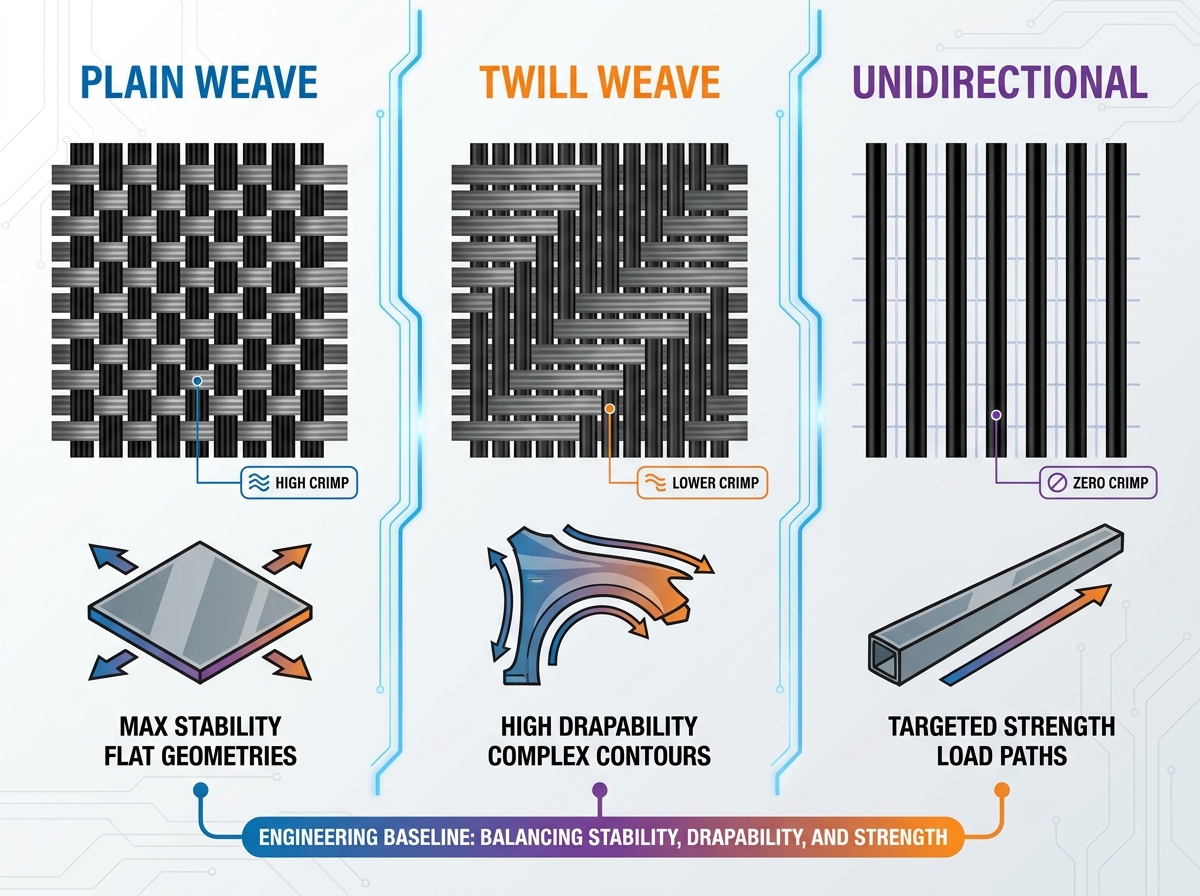
The structural mechanics of a twill carbon fiber fabric shift away from the rigid checkerboard pattern. Manufacturers typically construct this material using a 2-over-2-under (2x2) or 4-over-4-under (4x4) interlocking sequence. These longer stretches of uninterrupted fiber are known as "floats." Because the tows intersect far less frequently, this architecture significantly reduces overall crimp.
The advantages of this reduced crimp profoundly impact manufacturing capabilities. This architecture provides exceptionally high pliability. It effortlessly conforms to compound curves, deep draw molds, and highly complex radii. You can usually lay it down without darting, which is the undesirable practice of cutting relief slits into the fabric. Structurally, it delivers better ultimate tensile strength because the fibers remain straighter along their load paths. Furthermore, it provides the highly recognizable, deep-depth visual aesthetic preferred in automotive and high-end consumer goods.
Despite these benefits, engineers must manage several distinct processing limitations. The extended floats make it highly susceptible to "fiber washout." This occurs when the weave pattern physically distorts during resin application, squeegee pressure, or basic handling. A careless pull can ruin both the visual alignment and structural geometry. Furthermore, the edges fray quickly and aggressively if they are not carefully taped prior to cutting.
We see this architecture applied predominantly in visually demanding and geometrically complex sectors. Ideal use cases include intricate automotive body panels, motorcycle fairings, and contoured sporting goods. It serves as the undisputed industry standard for cosmetic surface layers on parts featuring intricate 3D geometries.
A unidirectional carbon fiber fabric abandons traditional weaving entirely. In this structural architecture, all primary carbon fibers run perfectly parallel along a single 0° axis. Manufacturers hold these parallel tows together using sparse, non-structural binder threads or fine epoxy webs. The focus remains entirely on single-axis performance.
The performance advantages here represent the theoretical pinnacle of composite engineering. Zero crimp ensures maximum translation of fiber strength directly into the finished part. Because the fibers never undulate, they immediately accept and distribute mechanical loads. This yields the highest possible stiffness and strength-to-weight ratio available in composite materials. It allows engineers to tailor part thickness exactly along known stress vectors. You only place material exactly where mathematical simulations demand it.
However, employing this material introduces significant engineering complexity. It possesses virtually zero transverse strength along the 90° axis. If left unsupported, a cured panel will easily split parallel to the fibers under minimal lateral force. Furthermore, it requires strict adherence to balanced, symmetric laminate schedules. Engineers typically stack plies in calculated sequences, such as 0°/90°/45°/-45°. Failing to balance these multi-axial orientations guarantees severe thermal warping during the cure cycle.
This highly specialized architecture belongs in uncompromising, load-bearing applications. Ideal use cases include spar caps in aerospace wings, custom-engineered bicycle frames, and focused structural reinforcements. It shines wherever high-tension load paths demand absolute rigidity without excess weight.
Choosing the correct material requires a disciplined, multi-variable approach. You must systematically evaluate your mold geometry, expected load paths, and final cosmetic requirements before finalizing your ply schedule.
To simplify this process, we recommend utilizing a structured decision matrix. First, conduct a thorough geometry check. Do your molds feature tight internal radii or challenging spherical curves? If so, you should immediately shortlist twill for its superior drapability. Is your component essentially a flat structural plate? Plain weave becomes your best option to guarantee maximum handling stability.
Next, perform a rigorous load path analysis. Is the part subjected to unpredictable, omnidirectional stresses? Woven fabrics offer safer, more robust multidirectional coverage for general impacts. Conversely, if your part experiences specific, predictable directional bending, unidirectional layers provide vastly superior optimization.
Finally, confirm your cosmetic requirements. Will the part be clear-coated for consumer display? A 2x2 twill remains the mandatory choice for your outermost surface ply to achieve the desired visual depth.
Table: Carbon Fiber Fabric Decision Matrix
Selection Criteria | Primary Geometry Focus | Load Direction Profile | Best Fit Architecture |
|---|---|---|---|
Maximum Stability | Flat panels, simple tubes | Omnidirectional (Symmetrical) | Plain Weave |
Maximum Drapability | Compound curves, tight radii | Omnidirectional (Symmetrical) | Twill Weave |
Maximum Stiffness | Linear beams, tailored structures | Highly Directional (Single Axis) | Unidirectional (UD) |
To maximize performance, industry professionals heavily rely on a hybrid layup strategy. This is a crucial best practice. We typically use a twill or plain weave for the outermost cosmetic layers. The woven structure protects the part against surface impact, prevents edge fraying, and delivers the expected visual appeal. Underneath this shell, we strategically utilize unidirectional layers in the core. We orient these hidden UD plies to handle the exact structural bending loads determined by engineering simulations.
Your chosen architecture significantly influences behavior on the shop floor. For example, weave density profoundly affects resin flow dynamics during the Vacuum Infusion Process (VIP). The tight intersections of a plain pattern naturally compress under vacuum, actively restricting fluid pathways. Twill patterns generally allow noticeably faster resin flow. The longer floats create better microscopic channels for the resin to traverse, decreasing dry-spot risks on large panels.
Handling characteristics also shift dramatically when you compare prepreg materials to dry fabrics. Prepreg rolls come pre-impregnated with a partially cured B-stage resin. This tacky resin securely locks the fibers in place. Consequently, a prepreg twill is much easier to handle than a dry twill. The resin mitigates the inherent stability disadvantages, allowing you to cut complex shapes without immediate edge disintegration.
You must also factor tow size into your processing strategy. Manufacturers group carbon filaments into standard sizes like 3K, 6K, and 12K (thousands of filaments per tow). Tow size physically scales the thickness and areal weight of the cloth regardless of the underlying weave pattern. A 12K plain fabric will be significantly heavier and thicker than a 3K plain fabric. This parameter directly impacts your total weight budgets and dictates how many plies you need to achieve your final targeted thickness.
Assess Resin Strategy: Choose less dense weaves for faster vacuum infusion.
Evaluate Prepreg vs. Dry: Use prepregs to stabilize difficult, highly drapable architectures.
Calculate Tow Sizes: Adjust your ply-count calculations based on the 3K or 12K tow specifications.
Selecting the optimal composite architecture is ultimately an engineering compromise between handling stability, mold conformability, and theoretical tensile strength. You sacrifice structural perfection for manufacturability when you choose a woven fabric. Conversely, you accept significant layup complexity when pursuing the absolute strength of unidirectional materials. Recognizing these trade-offs ensures fewer defects on the production floor.
Before ordering bulk material, finalize your multi-axial load path simulations and review your most challenging mold geometries. We strongly advise engineers to avoid relying solely on digital models. You should purchase small sample yards of different weaves to conduct physical drapability testing on prototype molds. This real-world validation prevents costly manufacturing bottlenecks before you commit to full-scale roll procurement.
A: Yes, this is standard practice. Outer woven layers provide impact resistance and aesthetics, while inner UD layers handle specific bending loads. Ensure the layup remains symmetric to avoid warping.
A: A 4x4 twill has longer fiber "floats" (over 4, under 4). It is even more drapable than 2x2 but is highly unstable and difficult to handle without distorting the weave.
A: Yes, indirectly. Unidirectional fabrics can achieve higher fiber volume fractions (less resin) because there are no crimped voids to fill. Woven fabrics naturally hold more resin in the interstices of the weave.


