
English 
+86-157-6313-9515
lina@hezongmaterials.com
lina@hezongmaterials.com
26 Jiashan Road, Chucun Town, Weihai City, Shandong Province, China


Views: 0 Author: Site Editor Publish Time: 2026-08-11 Origin: Site


Sourcing pre-impregnated composite materials represents a significant capital investment where procurement mistakes lead directly to scrapped parts, compromised structural integrity, and wasted labor. Buyers frequently mismatch material specifications with their facility's processing capabilities. Ordering autoclave-only prepregs for an out-of-autoclave facility is a common error that ruins production runs. Many also fail to account for cold-chain logistics or misjudge lead times for custom impregnation runs, resulting in production bottlenecks or premature resin advancement before the material even hits the mold.
Successfully navigating the market requires moving beyond basic weave preferences to rigorously evaluate technical data sheets (TDS), resin chemistry, cure cycles, and supplier inventory models before issuing a purchase order. Understanding the exact thermal and mechanical properties of the matrix is non-negotiable. By aligning your internal manufacturing capabilities with the precise specifications of the raw material, you eliminate costly trial-and-error phases on the shop floor.
Match Resin Systems to Processing Capabilities: Ensure the prepreg's cure profile aligns with your available equipment (autoclave, oven, or heated press) and target glass transition temperature (Tg).
Calculate True Yield vs. Roll Dimensions: Optimize material utilization by matching supplier roll widths (typically ranging from 6” to 50”) to your specific ply-cutting requirements to minimize off-cut waste.
Verify Cold-Chain Logistics: Prepreg viability is strictly governed by its out-life and freezer shelf life; verify that the supplier utilizes dry ice or refrigerated freight to prevent premature curing during transit.
Assess In-Stock Availability vs. Custom Runs: Differentiate between suppliers offering "in-stock and ready to ship" standard rolls versus those requiring extended lead times for custom resin filming and impregnation.
Demand Traceability: Require batch-specific documentation, including Certificate of Analysis (CoA) and Technical Data Sheets (TDS), to guarantee repeatable mechanical properties across production runs.
Establish the operational demands of the final composite part before looking at material catalogs. Continuous operating temperatures dictate the baseline resin chemistry required. A component resting near an exhaust manifold faces vastly different thermal realities than an interior cabin panel. Map out the mechanical load paths. Determine if the part will experience high-frequency fatigue, blunt impact, or sustained tensile stress. Exposure to corrosive elements, UV radiation, and aggressive solvents also narrows down your matrix options. You must define these parameters clearly to filter out incompatible materials early in the sourcing process. Consider galvanic corrosion risks if the carbon part interfaces directly with aluminum structures. In these cases, you need a prepreg system that includes an isolating glass layer.
Audit your internal manufacturing capabilities with absolute honesty. Document the maximum sustained temperatures your ovens or autoclaves can achieve and hold accurately. Evaluate your vacuum bagging proficiency. Achieving a perfect seal for an out-of-autoclave cure requires higher technician skill than relying on the brute force of autoclave pressure. Calculate your available -18°C (0°F) freezer storage capacity. Prepreg rolls are bulky. Ordering bulk quantities without adequate cold storage leads to rapid material degradation. A mismatch between facility infrastructure and material requirements guarantees manufacturing failure. Run a vacuum drop test on your standard bagging setup. If you lose more than 1 inHg over ten minutes, your shop is not ready for out-of-autoclave processing.
Utilizing expired or improperly specified prepreg carries a severe financial impact. High void contents drastically reduce interlaminar shear strength, leading to unpredictable part failure under load. Delamination during the demolding process ruins both the part and potentially the tooling surface. Tooling damage forces complete production halts while molds are repaired or remachined. Project delays compound these direct material losses, damaging client relationships and pushing delivery schedules weeks behind. The upfront cost of proper material evaluation is negligible compared to the downstream expense of processing incompatible composites. A single scrapped aerospace panel due to resin starvation can wipe out a month of profit.
Conduct a facility audit using these steps before ordering:
Verify oven thermocouple calibration across all heating zones.
Measure the exact internal dimensions of your freezer storage.
Test shop floor humidity levels, as high humidity affects tack.
Confirm vacuum pump CFM ratings can handle your largest envelope bags.
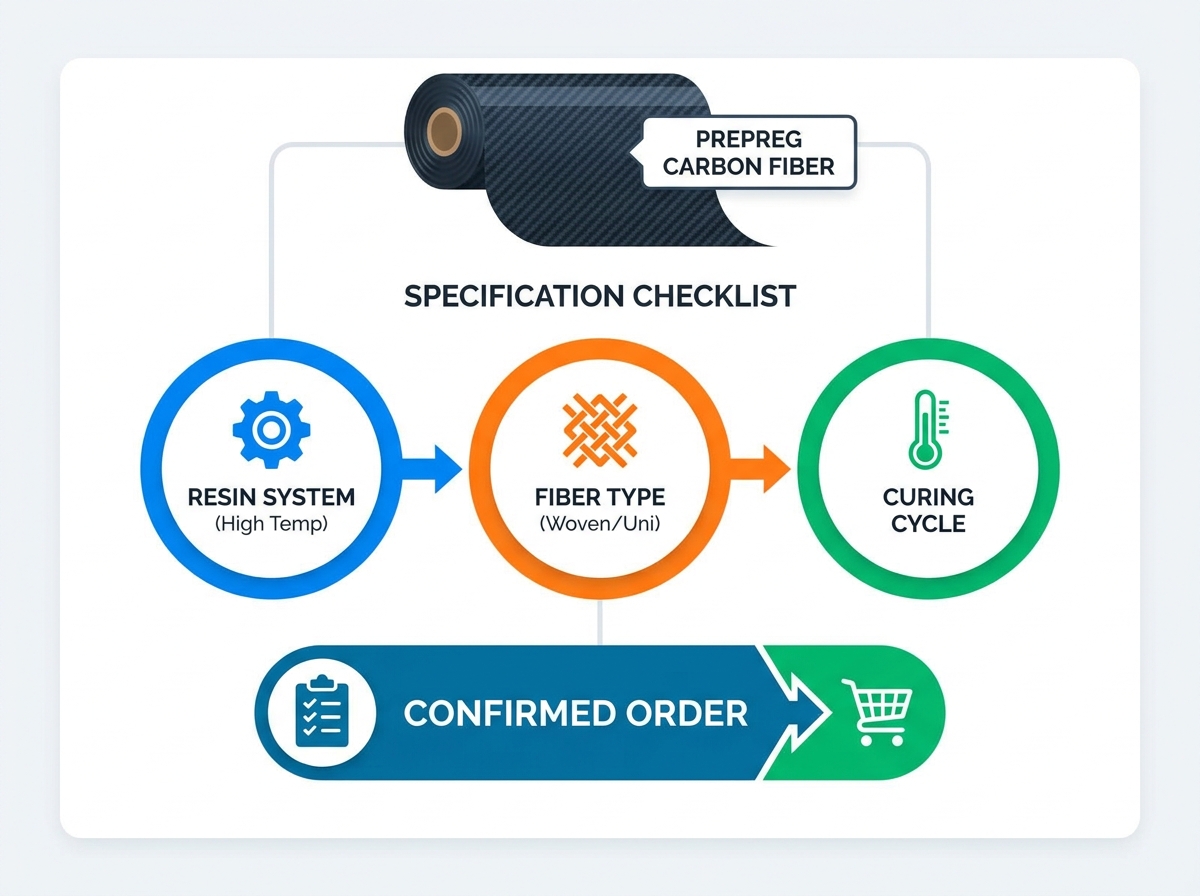
Evaluate the dry fiber weight required to achieve your target ply thicknesses and overall part weight. Common FAW values range from lightweight 200gsm fabrics for cosmetic layers to heavy 400gsm or 600gsm materials for rapid structural buildup. Strict FAW tolerances are necessary. A 5% variance in fiber weight across a 50-ply laminate alters the final part thickness significantly. This variance causes mold closure issues in closed-mold processes and alters the calculated mechanical properties of the finished component. Heavyweight fabrics build thickness quickly but struggle to conform to tight radii without darting.
Analyze the resin content percentage, which typically sits between 35% and 45% by weight. Understand how the resin matrix is applied. The hot-melt process combines a thin film of resin with the dry reinforcement via heated rollers. This method dictates the consistency of the resin fraction throughout the roll. Lower resin content yields higher specific strength but requires higher consolidation pressure to eliminate voids. Higher resin content improves the cosmetic surface finish and aids in flow but increases the overall weight of the part. Match the resin fraction to your consolidation method. Out-of-autoclave systems often run slightly higher resin contents to assist with flow under atmospheric pressure.
Define the required handling properties for your specific lay-up process. Tack refers to the stickiness of the prepreg. High tack is necessary for adhering plies to vertical mold surfaces without them sliding down. Drape refers to the material's ability to conform to complex shapes. High drape is essential for laying material into tight-radius geometries without wrinkling or bridging. Material that is too stiff will bridge across corners, resulting in resin-rich areas and structural voids after curing. Shop floor temperature heavily influences tack. A material that feels perfectly tacky at 75°F will feel stiff and boardy at 60°F.
Specify UD rolls for applications requiring maximum directional stiffness and strength. UD materials align all carbon fibers in a single direction, offering unparalleled mechanical performance along that axis. Note that UD often comes in narrower widths, typically ranging from 6-inch to 20-inch rolls. Laying up UD requires precise ply orientation to achieve the engineered load-bearing characteristics. Misaligning a UD ply by even a few degrees drastically reduces the laminate's overall strength. Splicing UD tapes requires staggered joints to prevent weak points in the laminate structure.
Evaluate woven prepregs for complex contours, multi-directional load bearing, and cosmetic surface finishes. A 2x2 twill weave offers an excellent balance of drape and stability, making it the industry standard for complex automotive and aerospace parts. Plain weaves provide high stability but lower drape, suitable for flat panels. Harness satin weaves offer exceptional drape for highly contoured molds but require careful handling to prevent fiber distortion during lay-up. Woven fabrics naturally resist crack propagation better than UD laminates due to the interlocking fiber bundles.
Address niche requirements carefully. Materials like aluminized fiberglass provide specific aesthetic or thermal reflection properties. While woven specialty fabrics are relatively easy to source, finding unidirectional variants of these niche materials often requires custom manufacturing runs. Custom runs demand higher minimum order quantities and extended lead times. Plan your production schedule accordingly if your design relies on non-standard reinforcement architectures. Surfacing films and lightning strike meshes fall into this category and must be integrated into the initial material procurement plan.
Assess standard 250°F to 300°F curing epoxies for general structural and cosmetic applications. These systems offer excellent mechanical properties, good adhesion, and manageable cure cycles. They are the workhorse of the composites industry, suitable for sporting goods, standard automotive panels, and general industrial applications. Standard epoxies typically provide a glass transition temperature (Tg) slightly above their cure temperature, which is sufficient for most ambient-temperature operating environments. They are generally easier to process and less sensitive to ramp rate variations than advanced chemistries.
Evaluate advanced matrix chemistries for components subjected to extreme thermal environments. Tooling, aerospace engine components, and motorsport exhaust surrounds require continuous service temperatures exceeding 150°C (300°F). In these scenarios, you must source a reliable high temp carbon fiber prepreg. Systems utilizing Bismaleimide (BMI), Cyanate Ester, or highly cross-linked high-Tg epoxies maintain their structural rigidity under intense heat. These materials require complex, multi-stage cure cycles and high-temperature post-cures to achieve their maximum thermal properties. Freestanding post-cures must be executed with precise ramp down rates to prevent thermal shock and micro-cracking in the laminate.
Review the inclusion of toughening agents for components subjected to high impact or fatigue loading. Standard epoxies can be brittle. To combat this, formulators add thermoplastic interleaves or rubber modifiers to the resin matrix. These toughening agents arrest crack propagation and improve the laminate's damage tolerance. Specify toughened resin systems for structural crash structures, landing gear doors, or any component where catastrophic brittle failure is unacceptable. Toughened systems often require specific cure pressures to ensure the interleaving layers bond correctly with the primary matrix.
Analyze the porosity risks and required debulking schedules for OOA prepregs. Confirm the resin system is specifically engineered for low-pressure consolidation. OOA systems rely on atmospheric pressure (typically 14.7 psi) to consolidate the laminate. Look for proprietary OOA systems designed with partially impregnated fibers. This engineered dry space acts as a vacuum channel, maximizing air evacuation before the resin flows and gels. Strict adherence to debulking schedules is mandatory to achieve low void contents without an autoclave. Edge breathing techniques using dry fiberglass strings are necessary to allow trapped air to escape the laminate during the initial heat ramp.
Specify autoclave-cure prepregs when targeting aerospace-grade void contents (less than 1%) and maximum fiber volume fractions. Autoclaves apply elevated heat and immense hydrostatic pressure (often 45 to 100 psi). This pressure crushes voids, forces resin into dry fiber bundles, and ensures perfect consolidation. Acknowledge the higher processing costs, massive equipment requirements, and nitrogen gas consumption associated with autoclave manufacturing. Autoclave prepregs generally have a higher initial resin viscosity, as the machine's pressure will force the flow during the cure cycle. Bridging in the vacuum bag will result in resin-rich corners, even under high autoclave pressure.
Matrix Type | Typical Cure Temp | Max Operating Temp (Tg) | Primary Applications | Consolidation Method |
|---|---|---|---|---|
Standard Epoxy | 250°F - 300°F | Up to 250°F | Sporting goods, automotive panels | OOA or Autoclave |
Toughened Epoxy | 250°F - 350°F | Up to 300°F | Crash structures, aerospace primary structures | Autoclave Preferred |
High-Tg Epoxy | 350°F + Post Cure | Up to 400°F | Composite tooling, high-heat automotive | Autoclave or Press |
Bismaleimide (BMI) | 375°F + High Post Cure | Up to 550°F | Aerospace engine nacelles, military radomes | Autoclave Only |
Calculate the cumulative time the material can remain at room temperature (typically 21°C/70°F) before losing tack and drape. This is the out-life. Every hour the material sits on the cutting table or in the mold counts against this limit. Once the out-life is exceeded, the resin advances too far to flow properly during the cure cycle, resulting in dry spots and structural failure. Implement strict time-tracking logs for every roll removed from the freezer. Use physical tags on the rolls to record time out and time in.
Confirm the maximum storage duration at -18°C (0°F). Most standard systems offer a freezer shelf life of 6 to 12 months from the date of manufacture. Avoid over-ordering. Buying in massive bulk to secure a discount is a false economy if half the material expires before you can process it. Rotate your inventory strictly using a First-In, First-Out (FIFO) methodology to ensure older material is consumed first. Install temperature alarms on your freezers. A weekend power outage will destroy your entire material inventory if left undetected.
Evaluate the supplier's shipping methods rigorously. Summer transit without proper thermal protection will drastically reduce out-life before the material even arrives at your dock. A roll sitting in a hot freight truck for three days can lose weeks of workable out-life. You must factor transit temperatures into your material handling procedures. Request that suppliers include digital temperature data loggers inside the shipping crates. This allows you to verify the exact thermal history of the material during transit.
Require moisture-barrier bagging, desiccant inclusion, and dry ice or temperature-controlled freight for bulk orders. Condensation is the enemy of prepreg. When a cold roll is exposed to humid ambient air, moisture condenses on the material. This moisture turns to steam during the cure cycle, blowing massive voids into the laminate. Rolls must be sealed in moisture-barrier bags and allowed to thaw completely to room temperature before opening.
Follow this strict thawing procedure to prevent condensation:
Remove the sealed roll from the freezer and place it on a clean rack.
Do not puncture or open the moisture-barrier bag.
Allow the roll to sit at room temperature for a minimum of 24 hours.
Verify the outside of the bag is completely dry and at ambient temperature before opening.
When evaluating prepreg carbon fiber for sale, you must look beyond the basic specification sheet. The supplier's operational model directly impacts your production efficiency.
Identify suppliers who maintain inventory for standard epoxies and weaves. This allows for rapid prototyping and agile manufacturing. Contrast this with suppliers who require 4-to-8 week lead times for custom impregnation. Custom runs offer exact resin fraction control and specific matrix chemistries but require rigid production forecasting to avoid stockouts. If your production schedule is volatile, prioritize suppliers with robust domestic warehousing.
Compare suppliers willing to sell partial rolls for prototyping versus those requiring full master roll purchases. A 10-yard cut is ideal for validating a new mold design or testing a cure cycle. Forcing a 50-yard master roll purchase for a small R&D project ties up capital and wastes freezer space. Negotiate MOQs based on your project phase. Establish a relationship where the supplier supports small-batch prototyping with the understanding of future high-volume orders.
Match the supplier's standard roll widths to your nesting software to minimize scrap rates. If your parts are narrow, cutting them from a 50-inch master roll generates massive off-cut waste. Factor in additional lead times if requesting custom slitting services. Cutting a master roll into 6-inch tapes optimizes yield for specific layups but adds processing time at the supplier level. Automated tape laying (ATL) machines require highly precise slit widths and specific spool core diameters.
Mandate that suppliers provide a Certificate of Conformance (CoC) with every shipment. Require material traceability back to the original carbon tow manufacturer. Up-to-date TDS and MSDS documents must be on file. Batch-to-batch consistency is mandatory. A slight variation in resin formulation between batches alters the cure kinetics, forcing you to recalibrate your oven profiles. Reject any shipment that arrives without proper batch documentation.
Evaluate the supplier's ability to provide tailored technical support. You need a partner, not just a distributor. They should offer specific cure cycle recommendations based on your part geometry and tooling material. Troubleshooting support for ramp rates, dwell times, and debulking intervals is invaluable when transitioning a new material into full-scale production. A supplier willing to send an application engineer to your shop floor during the first production run is worth a premium price.
Defect Type | Visual Indicator | Primary Cause | Prevention Strategy |
|---|---|---|---|
Porosity / Voids | Pinhole surface, spongy laminate | Inadequate debulking, moisture contamination | Strict debulk schedules, proper thawing |
Bridging | Resin-rich corners, missing fibers in radii | Poor drape, insufficient darting | Use harness satin weaves, dart plies in corners |
Resin Starvation | Dry, white fiber patches | Excessive bleed-out, low initial resin content | Use non-porous release film, verify RC% |
Exotherm | Charred resin, cracked laminate | Ramp rate too fast on thick parts | Slow ramp rates, add dwell steps |
Request the Technical Data Sheet (TDS) for your shortlisted materials and cross-reference the cure profiles with your oven capabilities.
Audit your freezer storage capacity to ensure adequate space for the required roll dimensions before placing a bulk order.
Order a small sample roll (5-10 yards) to validate tack, drape, and handling characteristics on your most complex mold.
Run a test cure cycle on a sample tool to verify resin flow behavior and final void content before committing to full production.
A: OOA prepregs utilize specially formulated resin systems designed to evacuate trapped air and achieve low void content using only atmospheric pressure (vacuum bagging) and an oven. Standard prepregs require the high hydrostatic pressure of an autoclave to crush voids and consolidate properly.
A: This is known as "out-life" and varies by resin system. Standard epoxy prepregs typically have an out-life of 14 to 30 days at 21°C (70°F). After this period, the resin advances too far, losing tack and failing to flow properly during curing.
A: High temp systems, such as specialized epoxies or BMIs, possess a high Glass Transition Temperature (Tg). This prevents the composite tool from softening, warping, or degrading when subjected to the repeated thermal cycling of curing production parts.
A: Yes, many industrial suppliers offer slitting services to cut master rolls (typically 50 inches wide) down to custom widths, such as 6-inch or 12-inch unidirectional tapes. Note that custom slitting often incurs additional lead times and minimum order quantities.
A: Opening a cold roll exposes it to ambient humidity, causing moisture to condense directly onto the material. During the cure cycle, this trapped moisture turns to steam, creating massive internal voids and completely ruining the structural integrity of the laminate.
A: Lower resin content (around 35%) yields higher specific strength and a lighter part but requires higher pressure to eliminate voids. Higher resin content (around 45%) improves the cosmetic surface finish and aids in resin flow but increases the overall weight of the component.


