
English 
+86-157-6313-9515
lina@hezongmaterials.com
lina@hezongmaterials.com
26 Jiashan Road, Chucun Town, Weihai City, Shandong Province, China


Views: 0 Author: Site Editor Publish Time: 2026-08-18 Origin: Site


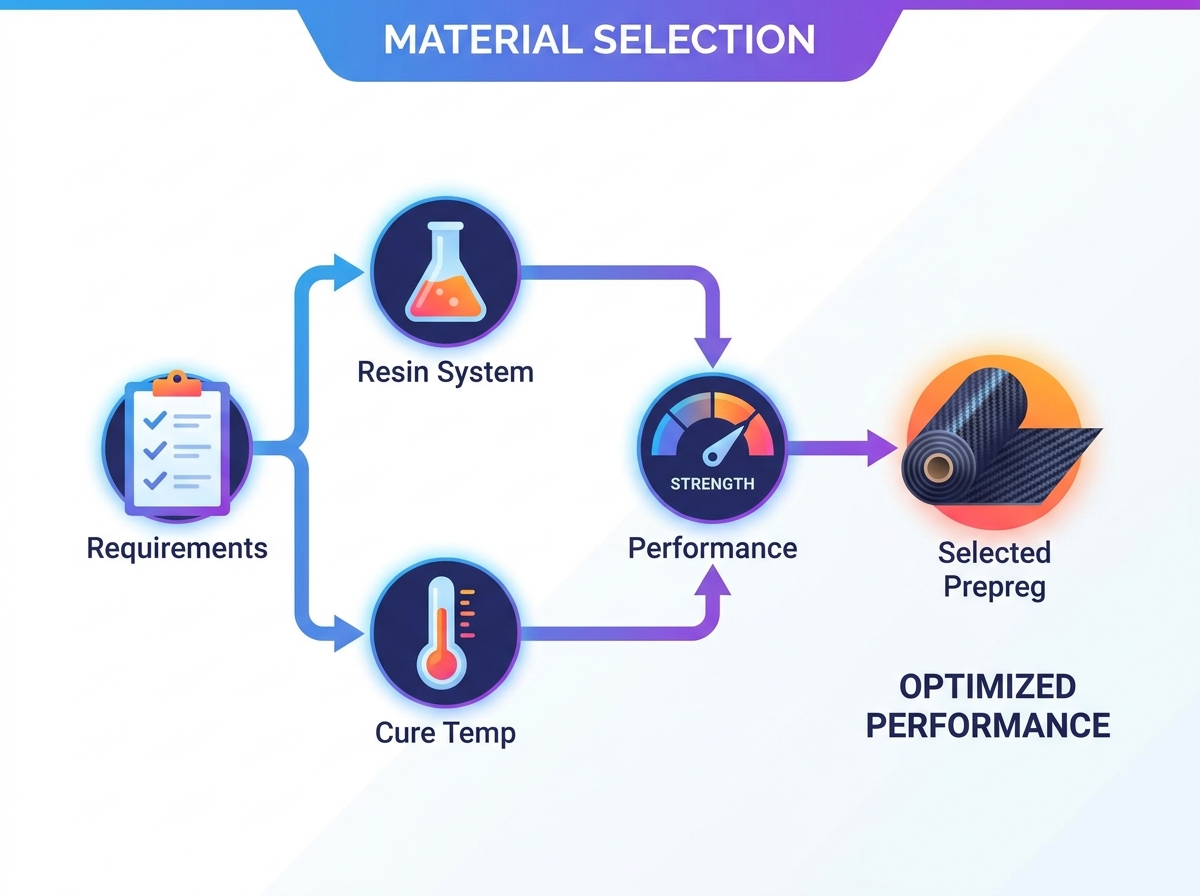
The specification of composite materials in aerospace manufacturing carries zero margin for error, where the balance between weight reduction, thermal stability, and structural integrity is non-negotiable. Selecting a pre-impregnated composite is rarely a straightforward fiber choice; engineers must navigate complex trade-offs between resin chemistry, cure kinetics, and existing manufacturing infrastructure. A mismatch leads to high void contents, exothermic degradation, or scrapped tooling. Unlike wet layup or resin infusion, prepregs eliminate mixing errors and guarantee precise resin-to-fiber ratios, but they introduce strict handling and thermal processing demands. This guide provides a technical evaluation framework for specifying aerospace carbon prepreg, breaking down resin system capabilities, curing methodologies, and the implementation realities of material handling, shipping logistics, and quality assurance.
Resin Chemistry Dictates Performance: While fibers provide tensile strength, the resin matrix (epoxy, BMI, or cyanate ester) governs the glass transition temperature (Tg), environmental resistance, and cure profile.
Processing Infrastructure is a Hard Constraint: The choice between autoclave and out-of-autoclave (OOA) prepregs must align with available capital equipment, tooling thermal mass, and acceptable void content thresholds.
Handling Parameters Impact Yield: Tackiness, drape, and B-staging directly influence layup efficiency, while strict cold chain logistics and out-life requirements dictate production scheduling.
Evaluation Requires a Systems Approach: Successful specification requires evaluating the material not just on cured mechanical properties, but on overall production economics, including freezer storage, tooling compatibility, and non-destructive testing (NDT) yield rates.
Aerospace structures demand rigorous mechanical baselines established through standardized testing. Tensile modulus dictates the stiffness of the component under load, typically verified using ASTM D3039 protocols. Compressive strength ensures the laminate can withstand crushing forces without micro-buckling, evaluated via ASTM D6641. Interlaminar shear strength measures the resin's ability to hold the carbon plies together under bending stress, tested through short-beam shear methods. You must establish these baseline properties using normalized fiber volume fractions before shortlisting any material for flight-critical applications.
Thermal boundaries dictate the operational limits of the cured composite. Operating temperatures determine the required Glass Transition Temperature (Tg). The Tg marks the exact thermal threshold where the polymer matrix transitions from a rigid, load-bearing state to a pliable, rubbery state. Dynamic Mechanical Analysis (DMA) is the standard method for determining this value, looking specifically at the onset of storage modulus drop. Continuous service temperature limits must remain at least 25°C below the wet Tg to prevent structural deformation under load. For components located near engine nacelles, exhaust systems, or leading edges subjected to aerodynamic heating, thermal stability takes absolute precedence over raw tensile strength.
Fire, Smoke, and Toxicity (FST) compliance adds a mandatory layer of regulatory complexity. Interior structural applications must meet strict Federal Aviation Administration (FAA) regulations regarding flammability, heat release, and toxic off-gassing. Exterior structures prioritize environmental resistance, lightning strike protection, and impact toughness over FST ratings. You must align the resin chemistry with the specific operational environment and regulatory envelope of the final part.
Material selection requires a direct assessment of your existing shop floor infrastructure. You must evaluate the coefficient of thermal expansion (CTE) of existing tooling against the prepreg's required cure temperature. Invar 36 tooling offers a CTE of approximately 1.2 ppm/°C, which closely matches carbon fiber. This prevents part distortion and residual thermal stresses during the cool-down phase. However, Invar is exceptionally heavy and requires massive heat input to reach cure temperatures. Aluminum 6061 tooling heats quickly but expands significantly (around 23 ppm/°C), which can lock complex parts onto the mold or warp tight tolerances during thermal cycling.
Heat capacity directly impacts the design of the cure cycle. A massive steel or Invar tool absorbs heat slowly, requiring extended ramp rates to ensure the laminate reaches the target temperature simultaneously across all zones. Carbon composite molds offer an optimal middle ground, providing favorable CTE characteristics and lower thermal mass, allowing for faster ramp rates. You must evaluate production throughput requirements versus material cure cycle times. Fast-curing resins increase throughput but often sacrifice high-temperature performance, out-life, or fracture toughness.
Epoxy formulations remain the dominant standard for primary and secondary aerospace structures. They offer a highly versatile balance of mechanical properties, interlaminar adhesion, and processing reliability. Factory-impregnated curing agents provide pre-catalyzed consistency. This eliminates the mixing errors, off-ratio blending, and variable resin-to-fiber ratios inherent in liquid molding processes like resin transfer molding (RTM) or wet layup. Every square meter of material delivers exact, repeatable performance straight from the freezer.
Specifying epoxy carbon fiber prepreg brings distinct manufacturing advantages. You gain excellent interlaminar adhesion, balanced fracture toughness, and highly predictable cure kinetics. The supply chain is robust, ensuring wide availability across various fiber areal weights, tow sizes (3K, 6K, 12K), and weave styles (plain, twill, unidirectional). Modern toughened epoxies incorporate thermoplastic interleaving particles between the plies to arrest crack propagation, making them ideal for impact-prone areas like wing skins and fuselage panels.
Despite their dominance, epoxies possess strict chemical limitations. Their upper thermal limits typically max out around 180°C to 200°C Tg for highly cross-linked systems. Pushing beyond this threshold requires transitioning to entirely different polymer chemistries. Epoxies also exhibit inherent moisture absorption characteristics. Over time, absorbed atmospheric moisture acts as a plasticizer within the polymer network, slightly lowering the effective Tg of the cured laminate. Engineers must factor this "wet Tg" degradation into the initial structural design margins.
Bismaleimide (BMI) systems are specified exclusively for high-heat zones. Engine nacelles, leading edges, and exhaust fairings require a Tg well above 250°C. BMI resins maintain exceptional mechanical retention and stiffness at elevated temperatures where epoxies would catastrophically fail. The trade-offs include inherent brittleness, poor tack, and highly complex processing requirements. BMI components demand high-temperature, freestanding post-cure cycles in an oven to achieve full chemical cross-linking. The initial autoclave cure only solidifies the part enough to survive demolding without distortion.
Cyanate Ester is the premier choice for space applications, satellite structures, and radomes. It features ultra-low moisture absorption and minimal outgassing in a hard vacuum environment, preventing contamination of sensitive optical sensors. Its superior dielectric properties and low loss tangent make it virtually transparent to radar and radio frequencies. While expensive and highly sensitive to moisture exposure during the uncured state, cyanate ester provides unmatched dimensional stability for antenna reflectors and deep-space structural trusses.
Polymer Matrix Performance Comparison
Polymer Type | Typical Max Tg (°C) | Primary Benefit | Typical Aerospace Application |
|---|---|---|---|
Standard Epoxy | 130 - 150 | Processing ease, high tack | Interior panels, secondary structures |
Toughened Epoxy | 180 - 200 | Impact resistance, damage tolerance | Primary flight structures, wings, fuselages |
Bismaleimide (BMI) | 250 - 300+ | Extreme thermal stability | Engine nacelles, aerodynamic leading edges |
Cyanate Ester | 200 - 250 | Low outgassing, dielectric clarity | Spacecraft structures, radomes, reflectors |
B-staging control strategies dictate how the material behaves on the shop floor. B-staging refers to the partial curing of the resin during the prepreg manufacturing process. This controlled reaction halts the chemical cross-linking at a specific point. It affects the shelf life and dictates how the resin will flow during the final thermal cure. Proper B-staging ensures the resin remains stable during freezer storage while retaining enough mobility to wet out the dry fiber bundles under heat and pressure.
Viscosity profiles require careful evaluation during the cure cycle design. You must identify the minimum viscosity point during the temperature ramp. If the viscosity drops too low, excessive resin bleeds out into the breather fabric, leaving a resin-starved, brittle laminate with poor shear strength. If the viscosity remains too high, the resin cannot flow enough to fill microscopic voids or consolidate the plies, resulting in unacceptable porosity. The temperature ramp rate must be precisely tuned to manage this viscosity window.
Tack and drape define the physical handling characteristics for the layup technicians. Tack is the surface stickiness required for vertical mold adhesion. Drape is the physical flexibility needed to conform to complex, double-curvature geometries without wrinkling or bridging. High tack aids in laying up vertical surfaces but makes repositioning misaligned plies difficult. Low tack allows easy sliding and repositioning but requires technicians to use heat guns to force adhesion. Balancing these properties ensures efficient layup without compromising fiber alignment.
Autoclave processing represents the gold standard for aerospace composites. The mechanics involve applying high hydrostatic pressure, typically between 85 and 100 psi, combined with elevated temperatures in a nitrogen-pressurized environment to prevent combustion. This massive pressure physically crushes trapped air, moisture vapor, and volatile gases. It forces the resin to flow uniformly through the fiber bed, ensuring complete wet-out. The result is an optimal fiber volume fraction (typically around 60%) and exceptional structural density.
Flight-critical primary structures mandate autoclave curing. Components like wing spars, tail assemblies, and pressure bulkheads require a void content of strictly less than 1%. Autoclave processing guarantees this level of consolidation. The high positive pressure overrides minor imperfections in the vacuum bagging process, ensuring a dense, void-free laminate capable of sustaining extreme cyclic flight loads over decades of service.
The drawbacks center entirely on infrastructure limitations. Autoclaves require massive capital expenditure for installation and certification. They consume enormous amounts of energy and require specialized operator training. Furthermore, the physical size of the pressure vessel dictates the maximum size of the composite part. If a wing skin exceeds the length of the autoclave, it must be manufactured in smaller sections and mechanically fastened, adding parasitic weight and assembly complexity to the aircraft.
Advancements in OOA resin formulations allow manufacturers to bypass the autoclave entirely. These resins are engineered to achieve low void contents using only atmospheric pressure (14.7 psi) and a high-quality vacuum (minimum 28 inHg). OOA prepregs feature engineered dry fiber channels within the partially impregnated tow. As vacuum is applied at room temperature, these channels evacuate trapped air and volatiles before the resin heats up, drops in viscosity, and flows to seal the laminate.
The strategic advantages of OOA curing are substantial for large-scale manufacturing. It enables the production of oversized structures without autoclave size constraints. Launch vehicle fairings, large wing skins, and massive single-piece fuselage sections can be cured in large, relatively inexpensive circulating air ovens. This removes the primary production bottleneck and dramatically reduces the energy consumption required for thermal processing.
Implementation risks require strict shop floor mitigation. OOA processing is highly sensitive to ambient moisture and handling errors. Without the crushing force of an autoclave, meticulous debulking is mandatory. Technicians must apply vacuum hold cycles for 15 to 30 minutes every three to four plies to extract air manually. The process demands absolute vacuum bag integrity. Even a microscopic leak in the bag will result in a porous, scrapped part, as there is no positive external pressure to counteract the leak.
Designing the thermal profile is a critical engineering task that dictates final part quality. You must program controlled ramp rates, dwell times, and cool-down phases based on the resin's specific chemistry. The ramp rate (typically 1°C to 3°C per minute) dictates how quickly the resin reaches its minimum viscosity. A dwell phase holds the temperature steady at an intermediate point, allowing the entire tool and part to equalize thermally before pushing to the final cross-linking temperature. The cool-down phase must be slow (under 2°C per minute) to prevent thermal shock, residual stress buildup, and part warpage.
Flexible cure cycles allow adaptation to specific manufacturing environments and tooling materials. Fast, low-temperature cures work well for thin parts on low-mass composite tooling. Extended, high-temperature profiles are necessary for thick laminates on massive Invar tools. The thermal mass of the mold dictates the lag between the oven air temperature and the actual part temperature. You must place lead and lag thermocouples directly on the part and the tool to monitor the true thermal reality, driving the oven controls based on part temperature rather than air temperature.
Managing exothermic reactions is vital in laminates thicker than 12mm (0.5 inches). As epoxy cross-links, it generates significant heat. Carbon fiber and the surrounding resin act as thermal insulators. In a thick part, the heat generated in the center cannot escape to the surface. This causes a thermal runaway, where the internal temperature spikes hundreds of degrees above the programmed oven temperature. This exotherm causes internal matrix cracking, severe charring, and catastrophic part failure. Stepped cure cycles with long, low-temperature dwells mitigate this risk by slowing the reaction rate.
Cold chain shipping logistics are mandatory from the moment the material leaves the manufacturer. Transit risks are mitigated through insulated dry ice packaging and continuous temperature data loggers. The material must remain frozen to prevent the curing agent from reacting with the base resin. If a shipment sits on a warm tarmac during transit, the resin begins to cross-link prematurely, destroying its tack and flow characteristics. Data loggers provide a verifiable audit trail, ensuring the material arrives in a pristine, uncompromised state.
Logistical demands require dedicated -18°C (0°F) freezer storage on the shop floor. Freezing effectively halts the resin's chemical cross-linking process. Industrial freezers must be equipped with backup generators and automated alarm systems. A power failure over a weekend can destroy hundreds of thousands of dollars worth of raw material. Proper inventory rotation using a strict First-In, First-Out (FIFO) methodology ensures older rolls are consumed before newer stock, minimizing waste.
Calculating out-life and mechanical life is a daily operational requirement for the quality assurance team. Out-life is the total cumulative time the material can spend at room temperature while retaining acceptable tack, drape, and flow. Mechanical life is the absolute maximum time before the cured properties degrade below specification. You must implement strict tracking logs. Every time a roll leaves the freezer, the clock starts. Technicians must log the exact hours the material is exposed to ambient conditions to prevent the use of expired material on flight hardware.
Thawing protocols demand strict adherence to prevent moisture contamination. You must allow rolls to reach ambient temperature entirely inside their sealed moisture barrier bags. If a cold roll is exposed to humid shop air, condensation immediately forms on the prepreg surface. During the cure cycle, this trapped moisture turns into steam, creating massive internal voids and delaminations. A standard 60-inch wide roll may require 24 to 48 hours to thaw completely before the bag can be opened safely.
Environmental controls dictate the layup environment. Cleanroom requirements for temperature and humidity are essential for consistent processing. Maintaining a stable 20°C to 22°C ensures consistent tack across all shifts. Controlling relative humidity below 50% prevents moisture absorption into the uncured resin matrix. Cleanrooms (typically ISO Class 8) also prevent particulate contamination. Dust, hair, or airborne debris trapped between plies act as stress concentrators, initiating delamination under cyclic flight loads.
Analyzing the premium cost of specialized materials requires a broad view of production economics. OOA prepregs typically carry a higher raw material cost per square meter compared to standard autoclave grades due to the complex resin formulation and engineered fiber impregnation techniques. However, this premium offsets the massive capital savings of bypassing autoclave installation. For new production lines or aerospace startups, avoiding a multi-million dollar pressure vessel significantly lowers the barrier to entry and accelerates facility commissioning.
Tooling cost implications scale directly with cure temperature requirements. High-temperature BMI cures demand expensive Invar tooling to maintain dimensional accuracy at 250°C. Lower temperature OOA epoxies can utilize cheaper composite or aluminum tooling. You must calculate the tooling amortization over the expected production run. Cheap tooling for a high-volume part often fails prematurely due to thermal fatigue, negating the initial savings and causing production delays.
Labor efficiency shifts dramatically when moving to pre-impregnated materials. You offset higher raw material costs with the complete elimination of labor hours previously spent on resin mixing, degassing, and wet layup preparation. The layup process becomes cleaner, faster, and highly repeatable. Implementing Automated Tape Laying (ATL) and Automated Fiber Placement (AFP) machines further reduces manual labor, allowing for rapid, precise deposition of material over large surface areas with minimal scrap.
Scrap rates directly impact the financial viability of composite manufacturing. Expired out-life is a primary driver of waste. If production delays occur, material sitting on the shop floor may time out and require disposal as hazardous waste. Handling errors, such as bridging plies in tight corners, failing to remove backing paper, or puncturing vacuum bags during loading, also generate scrap. Robust technician training programs and strict adherence to out-life logs are the only ways to mitigate these losses.
Quality assurance relies heavily on Non-Destructive Testing (NDT) to verify internal part integrity. Ultrasonic C-scanning is the standard method for detecting internal voids, porosity, and delaminations across large flat or slightly curved panels. The correlation between material processability and first-pass yield is absolute. Materials that are difficult to debulk or highly sensitive to ramp rates will fail NDT more frequently. Selecting a robust, forgiving resin system reduces NDT failure rates, ensuring parts move from the oven to final assembly without costly rework or material review board (MRB) interventions.
Request technical data sheets (TDS) from suppliers to compare glass transition temperatures, viscosity profiles, and out-life specifications against your shop floor capabilities.
Procure sample rolls for internal thermal analysis using Differential Scanning Calorimetry (DSC) to verify cure kinetics and establish baseline ramp rates.
Execute sub-scale layup trials on representative tooling to validate tack, drape, and manual debulking procedures under actual environmental conditions.
Perform ultrasonic C-scans on test laminates to confirm void contents remain strictly below the 1% threshold before approving full-scale production runs.
A: Autoclave prepregs require a pressurized vessel operating at 80-100 psi to compress the laminate and eliminate voids. OOA prepregs feature engineered dry fiber channels and specific resin flow characteristics to achieve low void contents using only atmospheric vacuum pressure and a standard circulating air oven.
A: B-staging refers to the partial curing of the resin system during the prepreg manufacturing process. It controls the material's tackiness, drape, and viscosity. This ensures the prepreg is stable for handling and freezer storage while still capable of flowing, wetting out fibers, and fully cross-linking during the final thermal cure.
A: When stored in a sealed moisture barrier bag in a freezer at or below -18°C (0°F), most aerospace prepregs have a shelf life of 6 to 12 months. Once removed from cold storage, the material has a limited out-life, often 14 to 30 days, during which it must be laid up and cured.
A: High void content is typically caused by insufficient consolidation pressure, vacuum bagging leaks, or inadequate debulking during layup. Trapped moisture from improper thawing also turns to steam during cure, creating voids. Additionally, an incorrect temperature ramp rate can cure the resin before entrapped air and volatiles escape.
A: While the initial cure of some BMI prepregs can occur in a standard composite oven or autoclave to achieve dimensional stability, they almost universally require a freestanding, high-temperature post-cure in an oven. This secondary cycle pushes the temperature above 227°C to achieve full chemical cross-linking and maximum thermal resistance.


