
English 
+86-157-6313-9515
lina@hezongmaterials.com
lina@hezongmaterials.com
26 Jiashan Road, Chucun Town, Weihai City, Shandong Province, China


Views: 0 Author: Site Editor Publish Time: 2026-08-25 Origin: Site


Advanced composites manufacturing relies on a strict threshold where material selection dictates both structural integrity and production viability. Engineers constantly balance target mechanical properties, such as ultimate tensile strength and modulus, against strict manufacturing constraints. Tooling limitations, thermal budgets, and the massive capital expenditure required for autoclaves force manufacturers to evaluate every material input meticulously.
Selecting the optimal carbon fiber epoxy prepreg requires a rigorous evaluation of resin content, precise cure temperature profiles, fiber compatibility, and material handling realities. You must balance these variables to ensure high-yield, defect-free production. Transitioning from wet-layup to pre-impregnated systems fundamentally shifts the focus from manual resin mixing to precise environmental and thermal management on the shop floor.
Resin Content Dictates Consolidation: The specific resin-to-fiber ratio (typically 33% to 42%) directly influences void content, part weight, and final mechanical performance.
Thermal Profiles Drive Tooling Decisions: Cure temperatures range from low-temp Out-of-Autoclave (OOA) systems (60°C–100°C) to high temperature prepreg carbon fiber systems (180°C+), dictating the required investment in molds and curing equipment.
Handling Realities Impact Yield: B-staging, tack, drape, and out-life must align with the manufacturer's layup complexity and shop-floor environmental controls.
Application-Specific Matching: Procurement must balance material cost against processing efficiency, matching the prepreg system to the specific regulatory and structural demands of aerospace, automotive, or industrial applications.
Consistent fiber wet-out and matrix distribution form the baseline requirement for any high-performance composite structure. Traditional wet-layup methods rely heavily on operator skill, making it impossible to guarantee uniform resin distribution across complex geometries. Pre-impregnated materials solve this baseline problem by delivering a strictly controlled ratio of resin to fiber directly from the manufacturer. The factory impregnation process, whether utilizing hot-melt or solvent-dip techniques, forces the epoxy deep into the carbon tow. This precision eliminates dry spots and resin-rich zones before the layup process even begins.
Engineers choose carbon fiber over glass or aramid alternatives due to its vastly superior specific strength and stiffness. When designing a laminate schedule, you must pair the epoxy matrix with the correct fiber grade to achieve the desired structural outcomes. Standard Modulus (SM) fibers provide excellent tensile strength and impact resistance, making them ideal for general structural use. Intermediate Modulus (IM) and High Modulus (HM) fibers sacrifice some ultimate strain to deliver maximum stiffness, which aerospace and motorsport applications heavily demand.
The epoxy matrix must chemically bond with the sizing applied to the carbon filaments. Sizing acts as a coupling agent, ensuring load transfer between the brittle carbon fibers and the ductile epoxy matrix. Mismatched sizing and resin chemistry lead to premature interlaminar shear failure, regardless of the fiber's theoretical strength. Manufacturers formulate specific epoxy blends to wet out these sized fibers perfectly, ensuring maximum translation of fiber properties into the cured laminate.
Fiber Grade | Tensile Modulus (GPa) | Tensile Strength (MPa) | Primary Application Focus |
|---|---|---|---|
Standard Modulus (SM) | 230 - 240 | 3500 - 4500 | General structural, automotive panels, sporting goods |
Intermediate Modulus (IM) | 270 - 300 | 5000 - 6000 | Primary aerospace structures, rotor blades, high-stress components |
High Modulus (HM) | 350 - 500+ | 2500 - 4000 | Spacecraft structures, precision optical benches, stiffening spars |
Manufacturers deliver prepreg materials in a B-staged condition. B-staging refers to a partial curing process that allows the epoxy to remain chemically stable at room temperature while retaining physical formability. This partial polymerization stops the resin from flowing off the roll but leaves enough reactive groups available to complete the cross-linking process during the final thermal cycle.
Viscosity control during the initial heating phase dictates the success of the consolidation process. As the oven or autoclave applies heat, the B-staged epoxy softens. The resin reaches a minimum viscosity point just before gelation occurs. At this exact thermal window, the resin flows sufficiently to evacuate trapped air and volatiles through the engineered breather channels. Operators must apply precise pressure during this phase to consolidate the plies without causing excessive resin bleed-out into the consumable bagging materials.
Shop-floor technicians evaluate prepreg primarily on two handling characteristics: tack and drape. Tackiness defines the material's adhesion during layup. It allows plies to stick to the mold surface and to subsequent layers without sliding. Drape measures the material's conformability over complex, multi-axis geometries without tearing or wrinkling the underlying fiber architecture.
These properties serve as primary factors in labor efficiency and layup accuracy. Ambient shop temperature and humidity drastically affect tack and drape during the material's out-life window. A cold shop floor renders the prepreg stiff and boardy, leading to bridging in tight corners. Conversely, excessive heat makes the resin overly aggressive, preventing technicians from repositioning plies during intricate layups. Facilities processing advanced composites maintain strict climate control, typically holding the layup room at 21°C (70°F) with relative humidity below 50%.
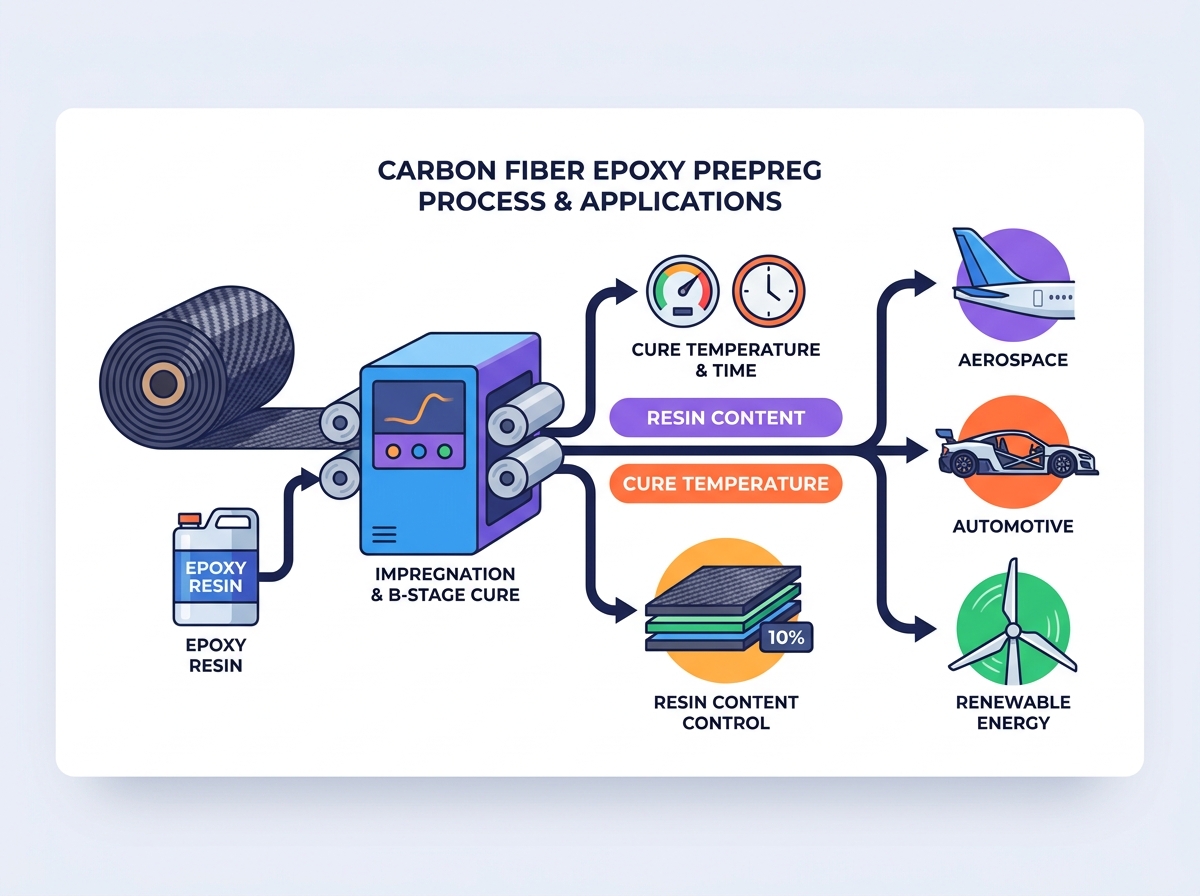
Material specifiers must map the specific percentage of resin to the physical outcomes of the cured laminate. Resin content (RC%) is not a variable you can adjust on the shop floor; you must specify it during the initial material procurement phase. The chosen percentage dictates the compaction behavior, the final part weight, and the ultimate mechanical limits of the structure. Quality control labs verify this metric using acid digestion or burn-off testing to ensure the delivered rolls match the technical data sheet.
Industry standards dictate specific RC% ranges based on the target application. Structural aerospace components typically utilize a 33% to 35% resin content by weight. This ratio provides enough matrix to transfer shear loads while maximizing the fiber volume. Cosmetic components or highly contoured parts often require up to 42% resin content. The excess resin ensures a pinhole-free surface finish and aids in filling tight radii during consolidation.
The theoretical maximum strength of a composite directly correlates to its Fiber Volume Fraction (FVF). FVF measures the actual volume of load-bearing fibers relative to the total volume of the cured part. Lower resin content prepregs yield higher FVF percentages, pushing the laminate closer to the theoretical strength limits of the raw carbon tow. Achieving a 60% FVF represents the gold standard for high-performance structural laminates.
Selecting a high resin content system offers distinct processing advantages. Technicians experience easier consolidation under lower vacuum pressures. The abundant matrix material flows readily, resulting in a superior surface finish directly off the tool and significantly lowering the risk of dry spots in complex molds. The trade-off involves increased overall part weight. High resin systems also carry the potential for resin-rich areas in deep draws, which ultimately lowers the overall specific strength of the component.
Conversely, specifying a low resin content system maximizes the strength-to-weight ratio. These materials strip away dead weight, leaving only the essential matrix required for load transfer. The critical trade-off lies in the processing requirements. Low resin prepregs demand high-pressure consolidation, typically requiring an autoclave, to physically force the plies together and prevent porosity and internal voids. Without sufficient pressure, a 33% resin system will fail to fill the interstitial spaces between the fiber bundles.
Resin Content (RC%) | Consolidation Difficulty | Surface Finish Quality | Specific Strength | Typical Application |
|---|---|---|---|---|
33% - 35% (Low) | High (Requires Autoclave) | Fair (May show fiber print-through) | Maximum | Primary aerospace structures, chassis tubs |
38% - 40% (Medium) | Moderate (OOA capable) | Good | High | Secondary structures, industrial components |
42%+ (High) | Low (Vacuum bag only) | Excellent (Pinhole-free) | Moderate | Cosmetic automotive panels, complex geometries |
Curing environments directly impact capital expenditure, tooling design, and material selection. The thermal profile required to cross-link the epoxy matrix dictates whether a manufacturer can utilize a simple heated blanket or must invest millions in pressurized autoclave infrastructure. Understanding the thermal dynamics of your chosen prepreg prevents catastrophic part failures during the cure cycle.
Vacuum-bag-only (VBO) or Out-of-Autoclave (OOA) prepregs rely on specialized resin chemistry and engineered dry fiber channels to evacuate air without positive pressure. These systems are designed to cure at lower temperatures. The industry sweet spot hovers around 100°C for common OOA applications, allowing manufacturers to achieve aerospace-grade void contents using atmospheric pressure alone.
The cost benefits of OOA processing are substantial. Manufacturers realize drastically reduced tooling costs by utilizing epoxy or low-temp composite molds instead of heavy metallic tooling. Furthermore, OOA processing eliminates the massive operational expenses associated with running and maintaining an autoclave. You can cure a 10-meter boat hull in a modular oven, a feat that would require a prohibitively expensive custom autoclave.
OOA curing emphasizes the strict need for good air circulation and thermal uniformity in curing ovens. You must prevent cold spots to ensure consistent cross-linking across the entire part geometry. OOA processing necessitates precise ramp rates, typically 1°C to 2°C per minute, and extended dwell times. These programmed thermal holds facilitate volatile evacuation through the vacuum manifold before the resin reaches its gelation point and locks the trapped air inside the laminate.
Certain engineering applications demand systems requiring elevated cure temperatures to achieve exceptionally high Glass Transition Temperatures (Tg). The Tg marks the point where the cured epoxy transitions from a rigid, glassy state to a pliable, rubbery state. To push this thermal boundary higher, manufacturers specify high temperature prepreg carbon fiber systems.
You will find the necessity of these systems absolute in environments subjected to extreme thermal cycling. Engine bays, exhaust surrounds, and primary aerospace structures require matrices that will not soften under operational loads. Curing these advanced systems demands specialized tooling. Manufacturers must utilize Invar, monolithic aluminum, or high-temp composite molds. These tooling materials possess the dimensional stability necessary to withstand 350°F+ curing cycles without suffering thermal distortion or severe Coefficient of Thermal Expansion (CTE) mismatch.
Establishing a decision framework requires comparing the high capital cost and superior consolidation of autoclaves against the accessibility and scalability of programmable curing ovens. Autoclaves utilize pressurized inert gas, typically nitrogen, to apply up to 100 psi of hydrostatic pressure to the vacuum-bagged part. This brute-force consolidation crushes voids, reliably yielding void contents below 1%.
Programmable curing ovens offer a highly scalable alternative for OOA materials. While ovens cannot apply positive pressure, they provide excellent thermal control for a fraction of the capital investment. Ovens allow manufacturers to cure massive structures, such as wind turbine blades or radomes, which would never fit inside a standard autoclave vessel. The choice between the two dictates the entire operational flow of the composites facility.
Processing Method | Capital Expenditure | Consolidation Pressure | Typical Void Content | Tooling Requirements |
|---|---|---|---|---|
Autoclave Curing | Extremely High | Atmospheric + up to 100 PSI | < 1% | Heavy metallic or high-temp composite |
Oven Curing (OOA) | Low to Moderate | Atmospheric Only (14.7 PSI max) | 1% - 3% | Low-temp composite, aluminum, or epoxy |
Heated Press | Moderate | High Mechanical Pressure | < 1% | Matched metal tooling (steel/aluminum) |
Adopting prepreg technology introduces hidden costs and specific failure points that wet-layup facilities rarely encounter. Material handling constraints dictate the rhythm of the shop floor. Failure to respect the chemical realities of B-staged epoxy leads to scrapped parts, wasted material investments, and compromised structural integrity.
Prepreg materials operate on a strict biological clock. You must understand the difference between freezer life and out-life. Freezer life typically extends for 12 months or more when the material is stored continuously at or below -18°C. At this temperature, the chemical cross-linking process essentially halts. When retrieving a roll from the freezer, operators must allow it to thaw completely at room temperature for 24 to 48 hours while still sealed in its moisture barrier bag. Opening the bag prematurely causes ambient humidity to condense on the cold resin, introducing moisture that will boil and cause severe porosity during the cure cycle.
Out-life defines the total accumulated time the material can spend at room temperature before the epoxy advances too far to process correctly. Out-life ranges from a few days for snap-cure resin systems to several weeks for standard structural epoxies. You must manage the logistical requirements for cold-chain shipping meticulously. Facilities utilize barcode scanning systems to track the exact hours a roll spends out of the freezer. Risks of exceeding out-life include a total loss of tack, premature cross-linking, and severely compromised consolidation during the cure cycle.
Even with premium materials, operators must actively mitigate common layup and curing defects through rigorous process control and standardized bagging sequences.
Porosity and Voids: Trapped air, moisture ingress, inadequate vacuum pressure, and poor oven air circulation cause porosity. You mitigate these issues by implementing aggressive debulking schedules. Operators apply a vacuum bag every three to five plies, pulling full vacuum for 15 minutes to compress the stack. Utilizing optimized ramp rates allows air to escape through the edge breather before gelation.
Bridging: Poor drape characteristics or inadequate corner compaction cause the carbon plies to pull away from tight radii, creating resin-rich voids known as bridging. Mitigation requires proper ply templating, darting techniques to relieve tension, and the use of silicone intensifiers to force the material deep into the tool corners under vacuum.
Exothermic Reactions: Thick laminates pose severe risks during the cure cycle. Epoxy cross-linking generates heat. In sections thicker than 10mm, rapid oven heating causes runaway thermal spikes inside the laminate because the core heat cannot escape. The core temperature exceeds the oven temperature, leading to catastrophic resin degradation, delamination, or even part fires. Mitigation requires slow ramp rates and intermediate thermal dwells to manage the exothermic energy release safely.
Aligning prepreg specifications with industry-specific success criteria ensures you extract the maximum value from the material. Different sectors prioritize entirely different performance metrics, driving the selection of specific fiber moduli, resin chemistries, and curing methodologies.
Aerospace applications operate under the strictest regulatory frameworks. Requirements include high temperature resistance, stringent lot traceability, FST (Fire, Smoke, Toxicity) compliance for interior components, and ultra-low void content for primary structures. Typical material selection involves 350°F curing toughened epoxies or BMI (Bismaleimide) systems. Engineers pair these advanced matrices with intermediate or high modulus fibers to maximize stiffness while surviving extreme environmental degradation and cyclic loading at altitude.
The automotive and motorsport sectors prioritize cycle time and impact resistance above all else. Requirements center on rapid cure cycles, high impact toughness for crash structures, and excellent cosmetic finish for exposed carbon panels. Typical selection involves 130°C–150°C press-cure or autoclave systems utilizing snap-cure epoxies. These resins feature optimized flow characteristics to wet out complex aerodynamic shapes rapidly while achieving full cure in under 15 minutes, allowing for high-throughput production lines.
Industrial applications, marine manufacturing, and sporting goods demand a balance of performance and economics. Requirements focus on cost-efficiency, scalable OOA processing, and moderate thermal resistance. Typical selection involves 100°C–120°C OOA systems. These materials are highly compatible with lower-cost tooling and standard modulus fibers, allowing manufacturers to produce large-scale structures, such as wind turbine blades or bicycle frames, without requiring massive autoclave infrastructure.
Carbon fiber epoxy prepreg operates as a highly engineered system rather than a simple commodity material. The resin chemistry, fiber modulus, thermal profiles, and your facility's manufacturing infrastructure must align perfectly to produce viable composite structures. Attempting to force a high-temperature aerospace prepreg through a low-temperature oven process will inevitably result in structural failure and wasted capital.
Evaluators should sequence their decision-making logic systematically. First, define the required Glass Transition Temperature (Tg) and the ultimate mechanical loads the part will endure. Second, assess your available curing infrastructure, specifically comparing autoclave capabilities against oven airflow uniformity. Finally, select the appropriate resin content and tack profile tailored to the specific part geometry and your shop floor's ambient conditions.
To move forward with material qualification, execute the following steps:
Request technical data sheets (TDS) from suppliers to verify exact cure cycles, out-life parameters, and mechanical baselines.
Procure sample rolls to conduct flat-panel testing, validating the material's drape characteristics and tack profile under your specific shop floor conditions.
Execute comprehensive thermal surveys on your existing curing equipment to ensure uniform air circulation and identify potential cold spots.
Establish strict freezer storage logs and out-life tracking protocols to prevent expired material from entering the production line.
A: Standard cure temperatures depend on the specific resin chemistry. Aerospace structural prepregs typically cure between 250°F and 350°F (120°C to 177°C). Low-temperature and Out-of-Autoclave (OOA) systems are engineered to cure between 140°F and 212°F (60°C to 100°C). For industrial OOA applications, 100°C serves as the most common baseline to achieve full cross-linking without requiring specialized high-temperature tooling.
A: Resin content dictates the balance between ultimate strength and consolidation ease. Lower resin content (33-35%) maximizes the fiber volume fraction, delivering the highest possible strength-to-weight ratio. Higher resin content (40-42%) provides a superior surface finish and makes consolidation easier in complex molds. However, excess resin increases the overall part weight and reduces the specific strength of the final laminate.
A: Freezer life is the duration the prepreg remains chemically stable when stored continuously below -18°C, often lasting 12 to 18 months. Out-life is the maximum cumulative time the material can spend at room temperature before the epoxy advances too far. Exceeding out-life results in a loss of tack and prevents the resin from flowing properly during the cure cycle.
A: Debulking involves applying a vacuum bag to the uncured layup at regular intervals, typically every three to five plies. This process physically compresses the layers and removes trapped bulk air between the plies. Consistent debulking prevents bridging in tight tool corners and drastically reduces the void content and porosity in the final cured composite structure.
A: Yes, if the oven can accurately maintain the required elevated temperatures. However, standard ovens lack the positive hydrostatic pressure provided by an autoclave. Curing high-temperature, low-resin systems in an oven without this pressure usually results in unacceptable void contents, poor interlaminar shear strength, and compromised structural integrity.
A: Porosity stems from trapped air during manual layup, moisture absorbed by the prepreg during its out-life, or inadequate vacuum pressure during the cure cycle. Heating the material too rapidly also causes porosity, as it traps expanding volatiles inside the laminate before the resin can flow sufficiently to evacuate them through the breather channels.


