
English 
+86-157-6313-9515
lina@hezongmaterials.com
lina@hezongmaterials.com
26 Jiashan Road, Chucun Town, Weihai City, Shandong Province, China


Views: 0 Author: Site Editor Publish Time: 2026-09-21 Origin: Site


Professional window cleaning and facility maintenance demand precise equipment to ensure safety and efficiency. Choosing the wrong gear quickly leads to operator fatigue, dangerous flex, or outright logistical nightmares during transport. A reliable extension system essentially forms the backbone of your entire daily operation. However, buyers frequently over-index on maximum extended length when evaluating options. They routinely ignore crucial factors like collapsed transport dimensions and the dynamic brush loads created under intense water pressure. This oversight commonly results in wobbly, practically unusable equipment at critical working heights. To fix this, we provide a rigorous, quantitative evaluation framework for specifying carbon fiber telescopic poles based on actual operational reality. You will learn exactly how to balance operational reach, material stiffness, and vehicle constraints. Stop relying on exaggerated spec-sheet maximums, and start building a smarter, safer equipment strategy today.
Working Height vs. Pole Length: True operational reach adds approximately 5-6 feet (operator height) to the pole’s extended length; over-buying length wastes money and adds unnecessary weight.
The Transport Constraint: Collapsed length must align with commercial vehicle storage limits and maneuverability in tight urban entryways.
Dynamic Deflection: Brush load and water weight exponentially increase pole flex at heights above 30 feet, requiring specific carbon modulus upgrades (e.g., standard vs. high-modulus).
Procurement Strategy: Fleet buyers should leverage custom carbon fiber manufacturing to spec exact clamp styles, section counts, and carbon weave (e.g., 3K, T300) rather than relying on off-the-shelf compromises.
Equipment procurement requires acknowledging the trade-off triangle. You must balance reach, stiffness, and weight. Extending the reach inherently compromises material stiffness. It also increases overall weight. You cannot maximize all three attributes simultaneously. You must alter the fundamental material grade to cheat these physics.
You must understand the difference between actual length and working height. Industry standards utilize a simple formula for procurement. You add the physical pole length to the operator's reach. This equals your true working height. Most operators provide an additional five to six feet of reach. Avoid paying a premium for a 40-foot pole. A 35-foot unit easily achieves the necessary 40-foot working height. Over-buying wastes capital. It also forces your team to lift unnecessary carbon tubing all day.
Carbon modulus dictates how the material behaves under stress. Modulus refers to the stiffness-to-weight ratio of the fibers. Standard modulus carbon suffices for 15 to 25 feet. High modulus becomes mandatory for 30 to 50 feet. Ultra-high modulus handles extreme heights exceeding 50 feet. Lower grades simply cannot maintain rigidity at extreme extensions.
Carbon Modulus Application Framework
Modulus Grade | Ideal Height Range | Operational Characteristics |
|---|---|---|
Standard Modulus (24-Ton) | 15 ft – 25 ft | Highly durable, slightly heavier, affordable. |
High Modulus (30-Ton) | 30 ft – 50 ft | Excellent rigidity, lighter weight, professional standard. |
Ultra-High Modulus (40+ Ton) | 50+ ft | Maximum stiffness, lowest weight, requires careful handling. |
You should maintain strong skepticism regarding marketing claims. Warn your procurement team against manufacturers advertising "100% carbon fiber" indiscriminately. They must specify the ton-rating or modulus type. Standard carbon will still exhibit a severe "noodle effect" at 40 feet. The pole will bend uncontrollably. Scrubbing glass becomes practically impossible. Always verify the specific material grade before ordering.
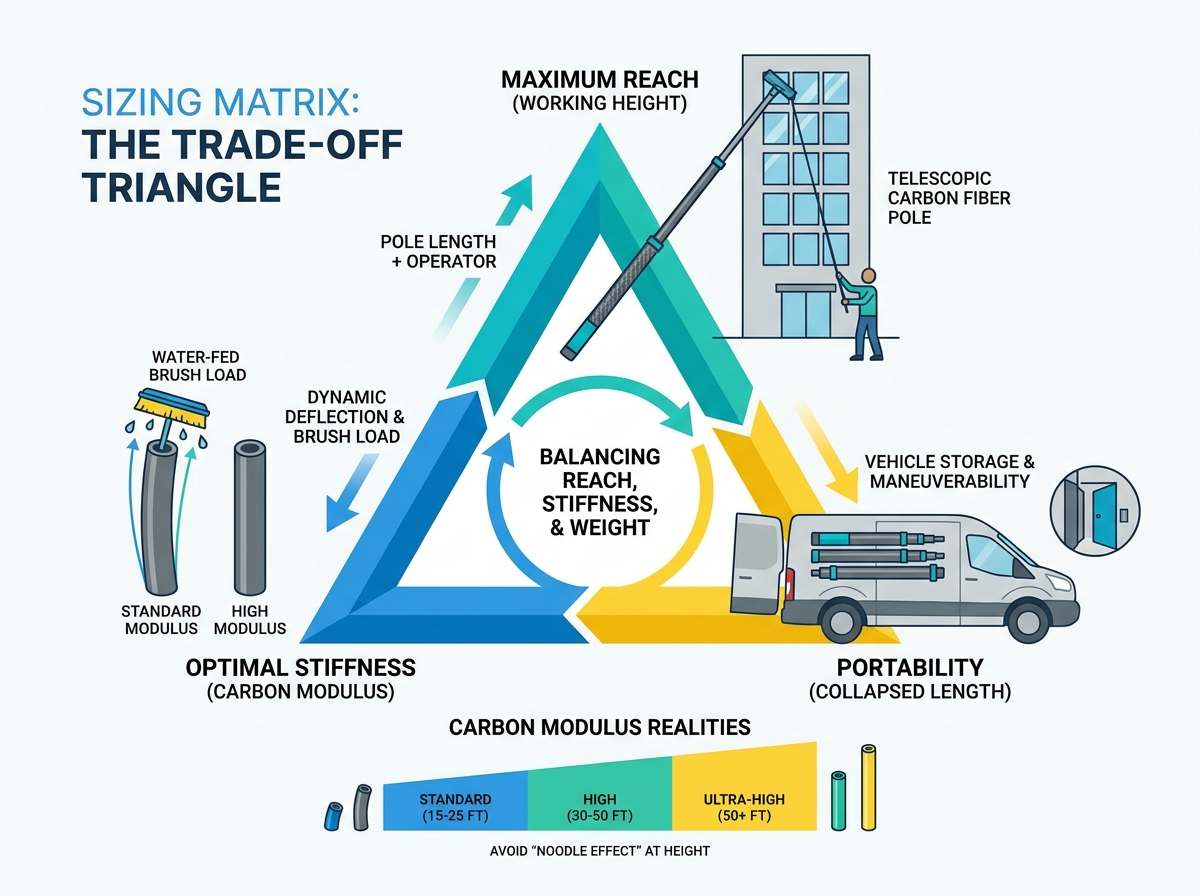
Extended reach means nothing if you cannot transport the equipment. Standard commercial vans dictate maximum collapsed lengths. Compact city vans hold much less than transit models. You must assess your internal racking systems before specifying section lengths. A pole hitting the passenger seat creates daily driving hazards. Measure the straight-line cargo space carefully. Base your purchasing decisions on these physical constraints.
Section count dramatically influences the collapsed dimension. This creates another unavoidable trade-off for buyers.
Fewer Sections: These units utilize longer individual tubes. They remain lighter and stiffer overall. They feature fewer overlap points. However, they possess a much longer collapsed length. Transporting them requires full-size commercial vehicles.
More Sections: These units break down into shorter pieces. They provide excellent tight-space navigation. You can fit them inside compact cars. Unfortunately, they increase overall weight. They also introduce potential flex due to more clamping points.
Indoor navigation requires careful consideration. You cannot maneuver a nine-foot collapsed tube inside a modern office building. Tight stairwells become impassable barriers. Standard elevators block entry entirely. Residential cleaning often involves walking through finished living rooms. You need short collapsed lengths for internal commercial atrium cleaning. Compact sizing protects the property. It prevents accidental drywall damage. It also projects a neat, professional image to the client.
Operators frequently ignore these confined space dynamics. They buy a massive pole for an exterior job. Then they drag the same bulky unit indoors. This causes property damage. Evaluate your daily route environment. Choose a section count matching your most restrictive physical space.
A static test rarely reveals a tool's true capability. A pole feels perfectly rigid resting horizontally on the ground. It feels entirely different vertically. Once you attach a water-fed brush and scrub a glass facade, dynamics change. Gravity pulls down on the system. Friction pulls horizontally across the glass. These opposing forces create immense physical strain on the operator.
Water-fed system variables complicate this further. You must factor in the weight of the water column. An internal hose filled with water adds substantial pounds. This weight hangs exactly where you do not want it. It acts like a pendulum. You must also consider the specific brush head size. A standard 10-inch nylon brush creates minimal drag. An 18-inch mixed-bristle brush creates massive surface friction. It acts like a sail catching the wind.
Excessive brush load causes deflection. Deflection is commonly known as system whip. When carbon fiber cleaning rods lack proper stiffness, they bow backward. You push forward, but the brush head lags behind. This delayed reaction reduces your scrubbing efficiency. It forces you to exert twice the energy. Operator strain increases rapidly. Fatigue sets in before the lunch hour. This directly impacts daily profitability.
We recommend a strict implementation rule. Look at your typical daily setup. Are you routinely using heavy double-trim brushes? Do you frequently scrub aggressive architectural angles? If yes, you must over-spec your rigidity. Move up one full tier in carbon modulus. If a standard pole suffices on paper, buy the high-modulus version instead. This prevents whip. It saves operator shoulders. It ensures maximum power transfer directly to the glass surface.
Off-the-shelf options serve independent operators perfectly well. They often fail spectacular stress tests in commercial fleets. Standard retail units fall short under extreme daily abuse. Specialized solar panel cleaning rigs require unique dimensions. High-volume fleet usage exposes every minor manufacturing weakness. Retail products simply utilize generic geometries to please the widest market. Fleet managers need specific tools for specific jobs.
This reality makes custom carbon fiber manufacturing a strategic necessity. B2B suppliers allow you to dictate the exact parameters. You stop settling for compromises. Custom specifying unlocks several major operational advantages.
Custom Section Lengths: You can dictate precise tube measurements. This ensures the gear fits your existing utility vehicles perfectly. No more modifying van racks.
Tailored Carbon Layups: You can adjust the material weave. Some operators add Kevlar reinforced base sections. This provides extreme impact resistance against concrete dropping.
Bespoke Clamp Integration: You can specify exact hardware tolerances. This allows seamless integration for your proprietary tool tips and specialized goosenecks.
Fleet operators see immediate return on investment. Custom manufacturing carries a slightly higher upfront cost. However, it scales incredibly favorably. Purpose-built tools reduce your annual replacement rates. They cut daily setup times across a dozen vehicles simultaneously. Standardized custom gear means every technician uses identical parts. Training becomes uniform. Inventory management becomes completely streamlined. You eliminate the chaos of running fifteen different retail pole brands.
Hardware dictates the practical lifespan of your equipment. Clamps remain the primary failure point. The carbon tubes rarely break under normal tension. Evaluate clamp mechanisms rigorously before buying. Lateral clamp mechanisms pull sideways to secure the tube. Vertical levers push down into the pole axis. Lateral styles often prove easier to adjust with cold, wet hands. Consider field serviceability heavily. Can your technician tighten a loose clamp using a standard coin? If they need specialized hex keys, you will lose productive field time.
Carbon wear prevention demands strict daily protocols. Daily grit infiltration destroys the structural integrity. Micro-sand particles enter the joint overlaps. They act like sandpaper every time you extend the sections. This degrades the inner carbon wall rapidly. You must evaluate poles featuring easy-to-disassemble sections. Your operators need to perform daily flushing. Rinsing out the joints extends the material life by years. Ignore this, and the sections will eventually jam permanently.
Modular replaceability saves enormous amounts of money. Accidents happen constantly on job sites. A heavy door might crush the bottom section. Ensure the manufacturer supplies individual replacement parts. A damaged base section should never force a full pole replacement. You simply order section number one. You slide it on, and the tool returns to service. Check the supplier's parts catalog before committing to their ecosystem. If they do not sell individual sections, find another manufacturer immediately.
The best cleaning pole is a mathematically sound compromise. You must balance your van length, working height, and dynamic rigidity. Ignore flashy marketing. Focus on actual material science and vehicle logistics. An optimized equipment strategy keeps technicians safe and profitable.
We recommend the following next steps to secure the right equipment:
Measure your exact vehicle storage space and internal racking constraints today.
Calculate your true 80th-percentile job height, adding operator reach to the equation.
Identify your heaviest wet brush setup to determine required stiffness.
Request formal technical spec sheets, highlighting carbon modulus and section weight, before issuing any purchase orders.
A: High-modulus is baked at higher temperatures to increase stiffness. It is required for poles over 30 feet to prevent excessive bowing, though it is slightly more brittle to side-impacts.
A: Yes, modular carbon fiber poles allow operators to drop base sections. Ensure the clamps are designed to operate independently without the base.
A: Slipping is a clamp tension issue, not a material issue. Regularly adjust clamp bolts and keep the carbon sections clean of soap residue and mineral buildup.
A: Not always. Many specialized B2B manufacturers offer low-volume prototyping for commercial cleaning fleets before requiring full-scale production runs.


