
English 
+86-157-6313-9515
lina@hezongmaterials.com
lina@hezongmaterials.com
26 Jiashan Road, Chucun Town, Weihai City, Shandong Province, China


Views: 0 Author: Site Editor Publish Time: 2026-09-14 Origin: Site


Insulation failure in low-voltage equipment carries severe operational stakes for manufacturers and end-users alike. Underspecifying these critical components inevitably leads to catastrophic electrical faults and failed safety compliance tests. Conversely, overspecifying materials needlessly inflates your bill of materials. The industry shift toward high-density, compact electrical designs has changed everything. This persistent trend significantly elevates the baseline requirements for both structural and dielectric materials. Equipment like compact switchgear, motor control centers, and distribution transformers now operate in increasingly shrinking footprints. They require robust solutions to maintain absolute electrical isolation.
A reliable specification strategy demands evaluating a precise engineering balance. You must accurately weigh mechanical load-bearing capacity against thermal thresholds and raw dielectric strength. Navigating these trade-offs ensures long-term operational safety. This guide details how to thoroughly evaluate and procure these essential components for production-scale manufacturing.
Specifying **epoxy fiberglass insulating cylinders** requires balancing conflicting properties, notably flame retardancy against raw dielectric strength.
Precise dimensional tolerances and machinability are critical to prevent delamination and ensure fit in high-density low-voltage assemblies.
Selecting the right grade (e.g., G10 vs. FR4 equivalent) depends strictly on the thermal class and compliance requirements (like UL94 V-0) of the end-product.
Supplier shortlisting should prioritize batch-to-batch consistency, in-house mechanical/electrical testing, and verifiable material traceability.
Traditional insulators often struggle in modern electrical environments. Legacy materials like cast resins or basic thermoplastics fail to meet dual demands. They cannot provide necessary structural support while maintaining flawless electrical isolation. Shrinking equipment footprints actively concentrate electrical stress and mechanical loads into smaller physical spaces. These older materials frequently warp, crack, or degrade under continuous duress.
Engineering teams are rapidly transitioning to specialized composites for the electric power industry. They offer superior reliability in densely packed layouts. By combining woven glass fabrics and epoxy resin binders, engineers create a matrix possessing exceptional durability. You gain a versatile material capable of handling extreme physical and electrical demands.
Fiberglass-reinforced epoxy matrices establish a much higher performance baseline. They provide superior tensile strength across various axes. They also resist mechanical shock remarkably well. Vibration proves detrimental in continuous-duty applications like motor control centers. Woven composites absorb and disperse this vibrational energy far better than legacy alternatives. When enclosures shrink, components sit closer together. You need insulation materials acting as rigid barriers. They must prevent short circuits while physically supporting heavy copper busbars.
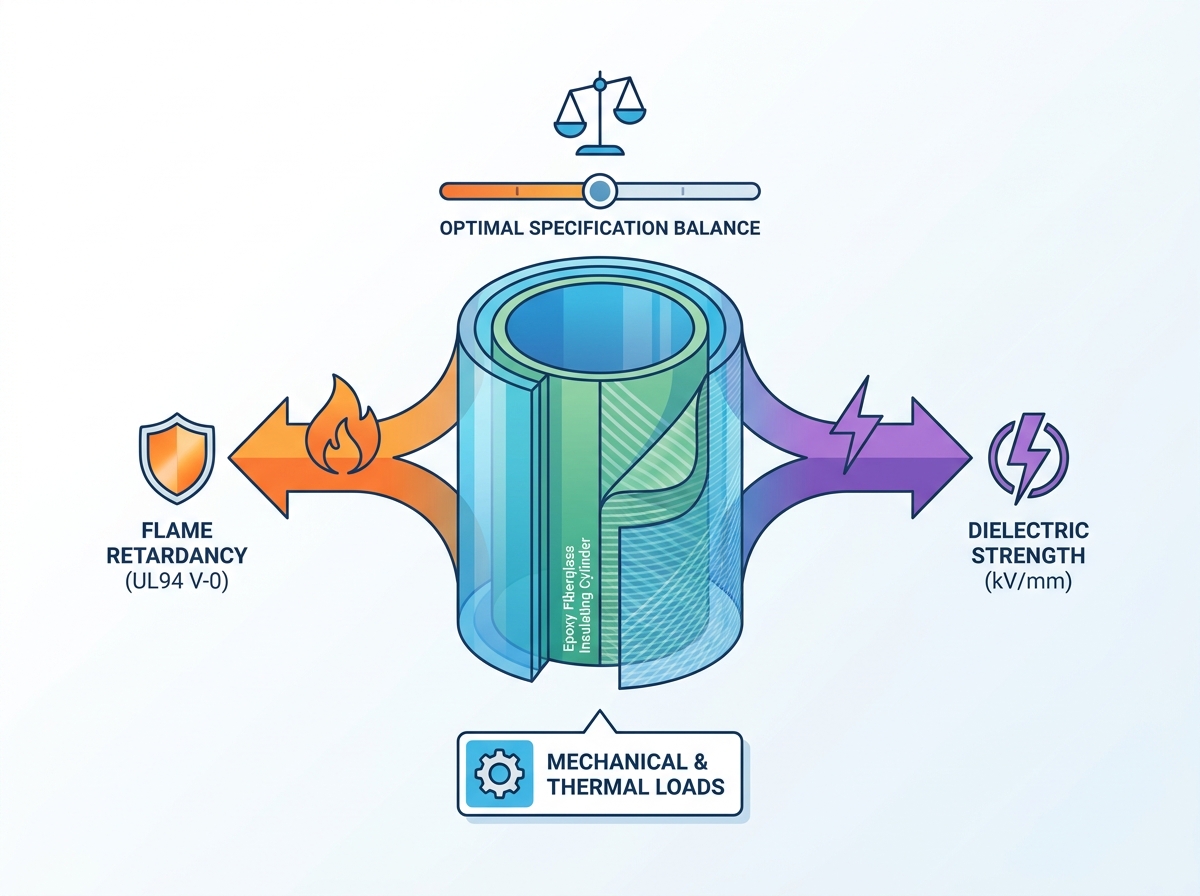
Chemical additives achieve vital flame resistance in composite materials. However, they incrementally compromise raw electrical insulation properties. Brominated compounds or halogen-free retardants disrupt the continuous polymer matrix. This disruption introduces microscopic impurities. It slightly lowers the dielectric breakdown voltage. You must balance these factors carefully during the design phase. Optimizing one property often penalizes the other.
Standard epoxy glass suits benign environments perfectly. It delivers maximum dielectric strength where fire risks remain negligible. You should specify flame-retardant epoxy glass fiber tubes when safety codes demand rigorous fire protection. FR4 specifications dominate these high-risk applications. They self-extinguish rapidly upon exposure to an open flame.
Navigating UL94 V-0 requirements for low-voltage switchgear requires diligence. You cannot over-sacrifice dielectric withstand voltage. You must also maintain a high Comparative Tracking Index (CTI). A low CTI leads to carbon track formation across the insulator surface. This tracking eventually causes catastrophic arc faults.
Engineers must adopt an evidence-based evaluation process. Request specific comparative test data from your suppliers. Do not accept generic datasheet maximums blindly. Ask for batch-specific testing reports covering both flammability and dielectric breakdown under operational temperatures.
Property Evaluated | Standard Epoxy Glass (e.g., G10) | Flame Retardant Equivalent (e.g., FR4) |
|---|---|---|
Flame Retardancy | Low to Moderate | High (UL94 V-0 Compliant) |
Raw Dielectric Strength | Excellent (Maximized) | Very Good (Slightly reduced) |
Comparative Tracking Index (CTI) | High | Moderate to High |
Typical Application Focus | Pure electrical isolation, submerged parts | Switchgear, enclosed low-voltage panels |
Low-voltage applications typically operate below 1kV. However, they still require substantial safety margins to handle transient spikes. Specify the required kilovolt per millimeter (kV/mm) ratings clearly. Proper creepage distance prevents surface flashovers. You must calculate these distances based on the anticipated pollution degree of the installation environment.
You must define criteria for flexural strength and compressive resilience. Often, epoxy fiberglass insulating cylinders act as structural standoffs or load-bearing shafts. They support heavy conductive components. If they lack adequate flexural strength, they will bend under continuous stress. This bending reduces air gaps and invites arc faults.
Thermal management plays an equally critical role. Match the material's Glass Transition Temperature (Tg) with the equipment's continuous operating temperature. Exceeding the Tg causes the composite to soften rapidly. It loses mechanical integrity and electrical resistance almost instantly. Align your material choice with recognized thermal classes.
Account for moisture absorption rates in non-hermetically sealed environments. High humidity impacts long-term resistivity negatively. Water ingress creates microscopic conductive pathways inside the resin matrix.
Thermal Class | Max Continuous Operating Temp | Application Suitability |
|---|---|---|
Class B | 130°C | Standard low-voltage indoor panels |
Class F | 155°C | High-density compact switchgear |
Class H | 180°C | Harsh industrial environments, heavy continuous loads |
Follow these steps to specify core parameters accurately:
Calculate peak transient voltage to establish baseline dielectric strength requirements.
Determine maximum physical load weights for components attached to the cylinder.
Identify the maximum internal ambient temperature of the enclosure under full load.
Assess the installation environment for average humidity and airborne contaminants.
Integrating rigid insulation components into tight low-voltage enclosures poses significant challenges. The assembly realities dictate extreme precision. Parts must align perfectly with threaded inserts and mounting brackets. A minor deviation causes assembly line bottlenecks. It also forces operators to apply undue mechanical stress to force the fit.
Improper machining creates severe delamination risks. Cutting, drilling, or threading operations require sharp tools and optimized feed rates. Low-tier suppliers frequently rush this process using dull tooling. This negligence leads to microscopic fractures within the glass matrix. These micro-fractures create hidden paths for moisture ingress and electrical tracking. Once a carbon track forms inside a fracture, failure becomes inevitable.
You must set strict tolerance requirements for physical dimensions. Inner diameter (ID), outer diameter (OD), and overall wall thickness require rigorous quality checks. Concentricity ensures even wall thickness throughout the cylinder. Uneven walls create stress concentrators during final assembly. These stress points fracture easily under operational vibrations.
Specify clean, finished parts explicitly in your documentation. Machining composite materials generates highly abrasive fiberglass dust. If suppliers ship uncleaned parts, this conductive dust contaminates your assembly line. It settles on sensitive electronics and contacts. You prevent widespread quality control issues by demanding thoroughly washed and sealed components.
Move beyond glossy marketing brochures. Demand empirical batch-testing data from prospective partners. A reliable manufacturer will readily provide documentation for dielectric breakdown tests and mechanical fracture tests. Validation over unsubstantiated claims protects your product's integrity. If a supplier hesitates to share raw testing data, you should eliminate them from your shortlist immediately.
Quality assurance and traceability act as your safety net. Establish strict requirements for ISO 9001 certification. You also need fully traceable raw material sourcing. You must know the exact origins of the resin systems and glass yarns used in your components. Traceability ensures consistency. If a field failure occurs, trace logs help isolate the specific defective batch rapidly.
Assess the supplier's capacity carefully. They must deliver low-volume precision prototypes reliably. More importantly, they must transition to high-volume manufacturing without experiencing tolerance drift. Many workshops build excellent prototypes but fail completely at scale. Request a pilot run to verify their tooling durability and process control methodologies.
Exact Technical Specifications: Detail kV/mm requirements, flexural strength limits, and target Glass Transition Temperature (Tg).
Detailed CAD Drawings: Provide 3D models highlighting critical dimensions, acceptable tolerances, and threaded insert locations.
Compliance Certificates: Demand proof of UL94 V-0 ratings and relevant IEC standards matching your target market.
Traceability Requirements: Mandate lot numbering and raw material origin certificates for every shipment.
Cleaning Protocols: Stipulate maximum allowable surface dust levels and specialized packaging requirements.
Specifying custom insulation components requires mastering engineering trade-offs. You constantly balance thermal endurance against raw electrical isolation and mechanical rigidity. Understanding these intersections prevents catastrophic failures in compact equipment designs. Relying on verified data rather than assumptions guarantees long-term operational success.
Urge your procurement and engineering teams to align on compliance needs immediately. Define UL and IEC requirements during the earliest conceptual design phases. Do not wait until prototyping begins. Finally, partner exclusively with manufacturers who provide transparent testing data. This collaborative approach eliminates hidden vulnerabilities in your final assembly.
A: FR4 incorporates brominated flame retardants to achieve UL94 V-0 compliance, making it self-extinguishing. G10 utilizes a standard epoxy composition without these additives. G10 offers slightly higher pure dielectric strength. You specify FR4 when low-voltage equipment requires strict fire safety codes, whereas G10 suits benign environments.
A: High-quality epoxy composites feature extremely minimal moisture absorption rates. However, in non-hermetic environments, prolonged humidity exposure allows trace water molecules into the matrix. This moisture creates microscopic conductive paths, gradually increasing leakage current and incrementally lowering the overall dielectric breakdown voltage over the component's lifespan.
A: Yes, they exhibit excellent machinability. However, you must carefully specify the thread pitch. Coarse threads work best. Fine threading risks severing too many continuous glass fibers, which compromises the matrix and causes structural delamination under mechanical loads.
A: You should request detailed reports on Dielectric breakdown voltage (ASTM D149), flexural strength (ISO 178), and certified UL94 flammability ratings. Additionally, ask for Comparative Tracking Index (CTI) results to ensure surface tracking resistance in dense environments.


